
Pakistan Aquamarine Context, Locality & Verification
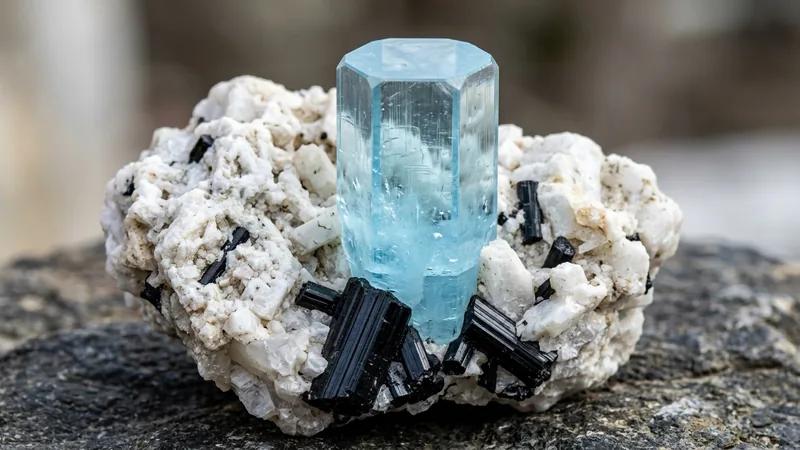
Pakistani aquamarine from the granitic pegmatites of Gilgit-Baltistan is celebrated globally for sharp hexagonal crystal terminations, exceptional transparency, and delicate pastel to deep sea-blue tones. A documented pegmatite occurrence or specimen does not establish bulk continuous commercial supply. Specimen evidence does not equal industrial stockpiles.
Mandatory Claim Boundary & Sourcing Notice: This page describes mineral/material evidence and buyer requirements. It does not represent current Enigma Earth inventory. Source, ownership, grade, quantity and availability must be verified for the specific enquiry.
Mineralogy & Geological Occurrence
Gilgit-Baltistan is recognized internationally as one of the premier geological provinces for collector-grade aquamarine and gemological faceting rough. Formed in miarolitic cavities within complex granitic pegmatite swarms that intrude high-grade metamorphic complexes, Pakistani aquamarines are distinctively untreated, exhibiting natural ice-blue to oceanic blue coloration.
Mineralization is hosted within Late Tertiary granitic pegmatites crosscutting the Karakoram Metamorphic Complex and the Kohistan-Ladakh Island Arc. Regional tectonic uplift and rapid unroofing created high-altitude miarolitic pockets (vugs) lined with pristine quartz, albite (cleavelandite), tourmaline, and tabular to elongated hexagonal beryl crystals.
Aquamarine is the pale blue to greenish-blue gem variety of beryl (Be3Al2Si6O18), colored by divalent iron (Fe2+) substituting in the octahedral channel sites. Unlike many global sources, Pakistani aquamarine is naturally blue upon recovery and rarely requires thermal heat treatment to remove yellow/green tones.
Pakistan Evidence & Regional Context
Aquamarine recovery in Gilgit-Baltistan is carried out by local artisanal mining cooperatives and private seasonal concessionaires operating high-altitude pocket extraction across glacial valleys.
Shigar Valley (Dassu, Nyet, Bulechi), Haramosh, Shengus & Nagar
Pakistan's premier pegmatite province; yields pristine gem crystals, museum-grade display matrix specimens, and clean faceting parcels.
Chitral (Lutkho, Garam Chashma, Arkari Valley)
High-altitude pegmatites crosscutting Hindu Kush metamorphic formations, yielding pale blue aquamarine crystals and associated collector minerals.
Commercial & Specimen Forms
Commercial requirements must strictly differentiate between raw extraction, sorted grades, and processed products.
Natural Aesthetic Matrix Mineral Specimens
Undamaged, pristine hexagonal aquamarine crystals naturally anchored on white albite (cleavelandite), mica, or schorl matrix rock, coveted by premier natural history museums and mineral collectors.
Faceting Rough Gem Parcels
Transparent, eye-clean crystal segments and fragments free of veil fractures, sorted for precision lapidary cutting into fine jewelry gemstones.
Faceted Collector & Fine Jewelry Gems
Expertly faceted emerald cuts, cushions, and ovals exhibiting high optical brilliance and delicate pastel sky-blue to deep sea-blue coloration.
Single Terminated Crystal Collector Floaters
Double-terminated or single-terminated loose hexagonal prismatic crystals exhibiting lustrous pinacoid faces, preserved as unmounted geological specimens.
Buyer Specification Requirements
Prospective buyers and project owners should specify the parameters below. Values represent typical industrial targets and do not imply universal Pakistani deposit compliance.
Gemological & Aesthetic Quality Parameters
4 ParametersMatrix & Specimen Integrity
2 ParametersConsignment & Secure Transport
3 ParametersTesting & Verification Requirements
Testing and quality verification must be conducted by an appropriate independent laboratory. Commercial transactions require representative sampling, assay, chemical analysis or gemological appraisal, and third-party inspection. Enigma Earth does not maintain a private testing monopoly.
Individual examination of each crystal or faceted gem under 10x achromatic optics and gemological polariscope. High-resolution UV-fluorescence and microscopic inspection to detect fracture filling or artificial specimen repairs.
- CIBJO Coloured Gemstone Nomenclature and Disclosure Standards
- ASTM E2499 (Standard Practice for Measuring Ultrasonic Properties of Solid Materials)
- Mineralogical Record Ethics in Mineral Sourcing and Specimen Repair Disclosure
Where high-value stones or major museum-grade specimens are involved, testing by recognized independent gemological laboratories (such as GIA, SSEF, Gübelin, or national gemological testing centers) confirms untreated natural origin.
Treatment, Condition & Specimen Quality Factors
Commercial specifications require explicit thresholds for penalty elements, structural soundness, color uniformity, and treatment parameters.
Parallel Hollow Growth Tubes & Rain Inclusions
Quality ParameterOperational Impact: Tubular two-phase liquid-gas inclusions parallel to the c-axis cause haziness or cat's-eye chatoyancy; degrades faceting yield
Undisclosed Crystal Repair or Glue Re-attachment
Quality ParameterOperational Impact: Specimens with crystals glued onto matrix rocks devalue drastically if undisclosed; violates international mineral ethics
Extraction Chipping & Contact Damage
Quality ParameterOperational Impact: Mechanical hammer blows during pocket extraction cause edge chipping and termination loss, reducing value by 50% to 80%
Sourcing, Provenance & Preparation Logistics
Due diligence guidelines for legal chain of custody, packaging standards, and maritime export protocols.
Commercial consignments must be sourced through licensed artisanal mining associations in Gilgit-Baltistan, backed by regional transit permits and verified valley provenance.
Mining in Gilgit-Baltistan is regulated by the Gilgit-Baltistan Minerals & Mines Department. Extraction operates within designated seasonal concession blocks.
- Individually carved polyethylene foam inserts contoured to the precise geometry of matrix specimens, housed in shockproof Pelican cases
- Traditional gemological flutes and padded jewelers' parcel papers for faceted stones and rough crystals
- Custom acrylic display pedestals with laser-engraved geological locality labels
Armored transit and insured courier logistics from Skardu/Gilgit through Islamabad international airport to global gemological and mineralogical auction hubs.
Relevant Regional Context
Related Minerals & Materials
Gemstone Verification & Sourcing Support
Enigma Earth provides technical due diligence, commercial facilitation, and exploration services to de-risk mineral procurement in Pakistan.
Gemstone & Specimen Procurement Facilitation
Direct pocket vetting, physical specimen appraisal, export clearance, and insured delivery coordination.
Mineral Exploration & Pegmatite Appraisal
Zoned granitic pegmatite mapping, geochemical fractionation profiling, and miarolitic vug exploration.
Mining Consultancy & Artisanal Mining Support
Low-impact non-destructive extraction methods, safety compliance, and community mining formalization.
Commercial Pathways for Aquamarine & Pegmatitic Beryl
Whether you are an international buyer seeking verified mineral supply or a licensed Pakistani mine operator looking to qualify off-take.
Mineral Buyers Registry
Review documented off-take requirements from industrial and international buyers.
Sell Your Mineral
Submit verifiable Aquamarine & Pegmatitic Beryl parcels, stockpiles, or concessions for third-party qualification.
Mining Tenders & Leases
Monitor provincial DGMM lease auctions, block bidding, and concession notices.
Pakistan Mining Regions
Explore provincial mineral directorates, logistics corridors, and geological belts across Pakistan.
What to Send: Gemstone Requirement Checklist
To evaluate feasibility and structure compliant off-take, please include the following technical details in your enquiry.
Frequently Asked Questions: Aquamarine & Pegmatitic Beryl
Key questions regarding Pakistani mineral availability, testing protocols, and trade qualification.
Yes. While global aquamarines (such as Brazilian rough) are frequently heated to 400°C to eliminate green tones, Pakistani aquamarines from Gilgit-Baltistan are predominantly naturally blue straight from the pegmatite pocket, making them highly prized by purist gem collectors.
Structure a Compliant Aquamarine & Pegmatitic Beryl Requirement
Submit required crystal dimensions, specimen aesthetics, or rough parcel tonnages for expert evaluation.