
Limestone Context & Industrial Requirements in Pakistan
Limestone deposits in Pakistan occur in massive marine formations across all four provinces. Industrial procurement must follow application-specific pathways: cement clinker manufacturing, quicklime calcination, ASTM C33 concrete aggregates, and high-purity chemical feedstock.
Mandatory Claim Boundary & Sourcing Notice: This page describes mineral/material evidence and buyer requirements. It does not represent current Enigma Earth inventory. Source, ownership, grade, quantity and availability must be verified for the specific enquiry.
Mineralogy & Geological Occurrence
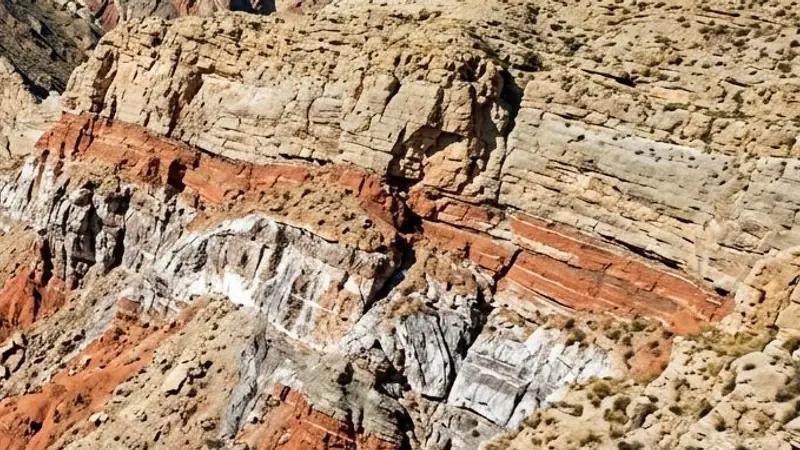
Pakistan contains vast limestone resources hosted within Paleozoic, Mesozoic, and Tertiary marine sedimentary successions. Formations range from high-purity micritic and crystalline limestones to siliceous and argillaceous varieties, supporting the country's cement manufacturing, construction infrastructure, and chemical processing industries.
Major stratigraphic units include the Eocene Margalla Hill Limestone and Chorgali Formation in Punjab and KP, the Jurassic Samana Suk and Cretaceous Kawagarh formations in the Hazara-Kohat fold belt, the Paleocene Lockhart Limestone in the Salt Range, and the massive Laki and Kirthar limestone suites in Sindh and eastern Balochistan.
Mineralogy is dominated by calcite (CaCO3), with subordinate dolomite, quartz, clay minerals (illite, kaolinite), and iron oxides. High-grade industrial varieties exceed 95% CaCO3 with low magnesium oxide (MgO < 1.5%) and alkali content.
Pakistan Evidence & Regional Context
Limestone is Pakistan's most extensively extracted non-metallic mineral, with positive official reporting across Punjab, Sindh, Khyber Pakhtunkhwa, Balochistan, and AJK. Operations range from large-scale captive quarries for automated cement plants to regional crushing complexes for aggregates.
Salt Range & Margalla Hills (Rawalpindi, Chakwal, Mianwali)
Massive Paleocene-Eocene formations quarried for major cement clusters and infrastructure aggregates; high chemical consistency.
Rohri, Jamshoro, Thatta & Hyderabad (Laki & Kirthar Suites)
Extensive Eocene limestone beds supporting southern cement plants, lime kilns, and coastal civil engineering projects.
Hattar, Nowshera, Nizampur & Kohat Formations
Thick Paleozoic to Tertiary limestone beds supplying cement plants and major regional aggregate demand.
Lasbela (Hub), Bolan Pass & Quetta (Chiltan Limestone)
Thick Jurassic platform carbonate successions utilized for metallurgical flux, industrial lime, and regional construction.
Commercial Forms & Processing Stages
Commercial requirements must strictly differentiate between raw extraction, sorted grades, and processed products.
Cement Clinker Feedstock
High-calcium limestone with controlled MgO (< 2.0%), low alkalis (Na2O + K2O < 0.6%), and consistent SiO2, Al2O3, and Fe2O3 ratios.
Quicklime & Hydrated Lime Kiln Feed
High-purity limestone (CaCO3 >= 95.0%) with low silica and sulfur, selected for shaft or rotary lime calcination into reactive quicklime (CaO).
ASTM C33 Construction Aggregates
Mechanically crushed, screened limestone aggregate for concrete, asphalt pavement course, and railway track ballast.
Micronized Ground Calcium Carbonate (GCC)
High-brightness, ultra-fine milled calcium carbonate used as functional filler in paints, plastics, paper, and sealants.
Buyer Specification Requirements
Prospective buyers and project owners should specify the parameters below. Values represent typical industrial targets and do not imply universal Pakistani deposit compliance.
Assay & Elemental Composition
6 ParametersMechanical & Physical Parameters (Aggregates)
4 ParametersCommercial & Delivery Parameters
3 ParametersTesting & Verification Requirements
Testing and quality verification must be conducted by an appropriate independent laboratory. Commercial transactions require representative sampling, assay, chemical analysis or gemological appraisal, and third-party inspection. Enigma Earth does not maintain a private testing monopoly.
Automated stream sampling of conveyor discharge or belt cuts in accordance with ASTM D75 for aggregates and ISO 3082 for bulk mineral lots. Quartering to produce representative testing portions.
- ASTM C25 (Standard Test Methods for Chemical Analysis of Limestone, Quicklime, and Hydrated Lime)
- ASTM C33 / BS EN 12620 (Standard Specification for Concrete Aggregates)
- ASTM C131 (Test Method for Resistance to Degradation by the Los Angeles Machine)
- ASTM C1260 (Standard Test Method for Potential Alkali Reactivity of Aggregates / ASR)
Buyers must establish which application pathway applies (cement, lime, aggregate, or filler) before issuing inquiries. Each pathway requires distinct accredited laboratory testing protocols.
Impurity Tolerances & Critical Penalty Factors
Commercial specifications require explicit thresholds for penalty elements, structural soundness, color uniformity, and treatment parameters.
Magnesium Oxide (MgO) in Cement Feed
Quality ParameterOperational Impact: Forms periclase during clinker burning, which hydrates very slowly with large volume expansion, causing delayed cracking and unsoundness in concrete structures
Alkali-Silica Reactivity (ASR)
Quality ParameterOperational Impact: Presence of microcrystalline or strained quartz silica reacts with cement alkalis to form expansive gel, destroying concrete integrity
Chlorides and Total Sulfur
Quality ParameterOperational Impact: Chlorides accelerate corrosion of reinforcing rebar in concrete; sulfur causes premature refractory ring build-up in cement kilns
Flakiness and Elongation Index (Aggregates)
Quality ParameterOperational Impact: Flat or elongated stone fragments fracture easily under compaction and increase concrete water demand
Sourcing, Provenance & Preparation Logistics
Due diligence guidelines for legal chain of custody, packaging standards, and maritime export protocols.
All limestone consignments must carry valid provincial Directorate General of Mines & Minerals (DGMM) dispatch passes, confirmed concession coordinates, and environmental clearance certificates.
Quarries operate under provincial mining leases. Environmental safeguards, blasting permits, and dust suppression compliance are mandatory regulatory requirements.
- Bulk open-top dumper trucks with tarpaulin covers for domestic industrial delivery
- Bulk open-top railway freight wagons for long-distance transport from the Salt Range
- Bulk carrier vessels for coastal and maritime export via Port Qasim
High-tonnage road haulage or dedicated unit freight trains connecting inland quarries to consumer plants or seaports.
Relevant Regional Context
Technical Support for Mineral Evaluation & Supply
Enigma Earth provides technical due diligence, commercial facilitation, and exploration services to de-risk mineral procurement in Pakistan.
Mining Operations & Quarry Development
Quarry planning, mechanized bench development, crushing optimization, and production QA/QC.
Mining Consultancy & Concession Diligence
Provincial lease title verification, reserve estimation, and environmental permitting advisory.
Mineral Trading & Export Facilitation
Bulk freight coordination, quality inspection, and port clearance management.
Commercial Pathways for Limestone (Industrial & Construction)
Whether you are an international buyer seeking verified mineral supply or a licensed Pakistani mine operator looking to qualify off-take.
Mineral Buyers Registry
Review documented off-take requirements from industrial and international buyers.
Sell Your Mineral
Submit verifiable Limestone (Industrial & Construction) parcels, stockpiles, or concessions for third-party qualification.
Mining Tenders & Leases
Monitor provincial DGMM lease auctions, block bidding, and concession notices.
Pakistan Mining Regions
Explore provincial mineral directorates, logistics corridors, and geological belts across Pakistan.
What to Send: Technical Requirement Checklist
To evaluate feasibility and structure compliant off-take, please include the following technical details in your enquiry.
Frequently Asked Questions: Limestone (Industrial & Construction)
Key questions regarding Pakistani mineral availability, testing protocols, and trade qualification.
Not necessarily. Concrete aggregates are selected primarily for mechanical strength, low abrasion, and absence of reactive silica (ASR), without regard to exact carbonate chemistry. Cement manufacturing requires strictly controlled CaCO3 (> 80%), low MgO (< 2%), and low alkalis, which many aggregate limestones do not meet.
Structure a Compliant Limestone (Industrial & Construction) Requirement
Submit technical specifications, target application pathways, and volume requirements for structured verification.