
Rock Salt & Pink Salt Context in Pakistan
Commercial rock salt from Pakistan comprises natural crystalline halite extracted from the Salt Range. Requirements should specify chemical purity (NaCl %), moisture, particle gradation, and packaging. Enigma Earth treats rock salt strictly as an industrial and edible food ingredient, rejecting unscientific health, detox or therapeutic claims.
Mandatory Claim Boundary & Sourcing Notice: This page describes mineral/material evidence and buyer requirements. It does not represent current Enigma Earth inventory. Source, ownership, grade, quantity and availability must be verified for the specific enquiry.
Mineralogy & Geological Occurrence
Pakistan contains one of the earth's largest and oldest rock salt provinces, stretching over 300 kilometers across northern Punjab. Known internationally as 'Himalayan Pink Salt', the deposits are massive underground stratabound sequences of high-purity halite (NaCl) interspersed with thin marl and anhydrite seams.
The salt beds belong to the Neoproterozoic to early Cambrian Salt Range Formation, deposited in a restricted marine evaporite basin along the northern margin of the Indian shield. Underground extraction is conducted predominantly via room-and-pillar mining at Khewra, Warcha, and Kalabagh, preserving structural stability and avoiding blasting impurities.
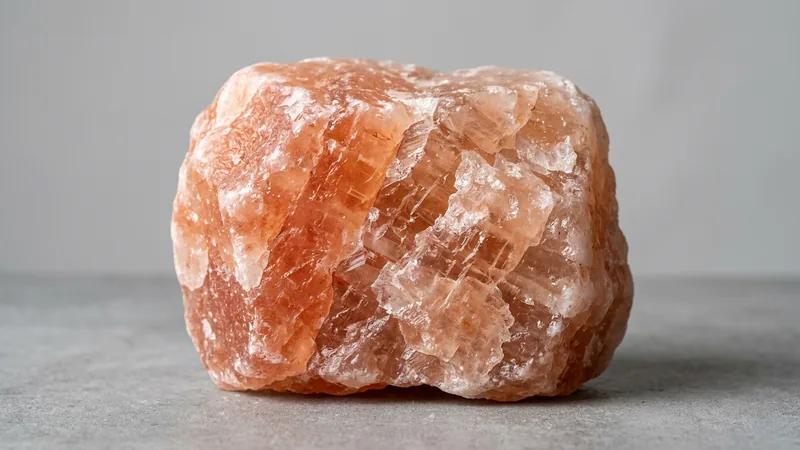
The mineral is predominantly halite (NaCl >= 96% - 99%). Natural coloration ranging from crystalline white and delicate peach to deep reddish-pink is caused by sub-microscopic inclusions of iron oxides (hematite, Fe2O3) and polyhalite within the crystalline matrix.
Pakistan Evidence & Regional Context
Rock salt is extensively mined under state-owned enterprises (such as Pakistan Mineral Development Corporation / PMDC) and licensed private concessionaires, producing millions of metric tons annually for chemical industries, de-icing, and food consumption.
Salt Range (Khewra, Warcha, Kalabagh, Jhelum, Mianwali)
The epicentre of commercial salt extraction in Pakistan. Khewra is one of the world's oldest operating mines; Warcha produces high-purity white and pale pink industrial/edible salt.
Kohat Salt Basin (Bahadur Khel, Jatta, Karak)
Thick Tertiary evaporite sequences producing grey and dark crystalline rock salt utilized primarily for regional livestock and industrial applications.
Salt Product Forms & Processing
Commercial requirements must strictly differentiate between raw extraction, sorted grades, and processed products.
Edible Gourmet Table & Grinder Salt
Optical sorted, crushed, washed, and dried pink salt granules intended for direct human consumption, spice blending, and consumer refill packaging.
Chlor-Alkali Chemical Grade Salt
High-purity raw or washed halite rock delivered to chlor-alkali chemical plants for electrolytic production of chlorine, caustic soda (sodium hydroxide), and soda ash.
Raw Bulk Salt Lumps
Unprocessed mine-run boulders extracted by mechanical undercutting, shipped in bulk for overseas crushing, decorative crafting, or industrial processing.
Architectural & Specialty Salt Tiles
Precision diamond-sawn rectangular bricks and slabs utilized in architectural installations, decorative wall cladding, dry-aging meat lockers, and wellness spa construction.
Buyer Specification Requirements
Prospective buyers and project owners should specify the parameters below. Values represent typical industrial targets and do not imply universal Pakistani deposit compliance.
Chemical Composition & Purity
5 ParametersContaminant & Food-Safety Standards
3 ParametersPackaging & Logistics
3 ParametersTesting & Verification Requirements
Testing and quality verification must be conducted by an appropriate independent laboratory. Commercial transactions require representative sampling, assay, chemical analysis or gemological appraisal, and third-party inspection. Enigma Earth does not maintain a private testing monopoly.
Representative sampling of packaged lots or flowing processing lines according to ISO 24333 / Codex Alimentarius CXS 150-1985 guidelines for food-grade salt.
- Codex Alimentarius Standard for Food Grade Salt (CXS 150-1985)
- ISO 2481 (Sodium chloride for industrial use — Determination of halogens)
- ISO 2482 (Determination of calcium and magnesium)
- ISO 22000:2018 (Food safety management systems)
Edible salt export consignments require certified certificates of analysis from accredited analytical laboratories, confirming heavy metal safety, iodine levels (if iodized), and microbiological cleanliness.
Purity, Contaminants & Quality Factors
Commercial specifications require explicit thresholds for penalty elements, structural soundness, color uniformity, and treatment parameters.
Water-Insoluble Marl & Clay Residue
Quality ParameterOperational Impact: Creates cloudy dissolution in food applications and leaves undesirable gritty sediment in consumer table salt
Moisture Absorption & Caking
Quality ParameterOperational Impact: Halite is naturally hygroscopic above 75% relative humidity; excess moisture induces severe bag hardening and caking
Heavy Metal Exceedances
Quality ParameterOperational Impact: Violates international food safety directives (EU, US FDA, CODEX); leads to border rejection
Visual Color Inconsistency
Quality ParameterOperational Impact: Natural salt seams vary from light peach to deep ruby; uneven blending causes customer disputes
Sourcing, Provenance & Preparation Logistics
Due diligence guidelines for legal chain of custody, packaging standards, and maritime export protocols.
Authentic Pakistani rock salt originates exclusively from the Salt Range and Trans-Indus basins. Consignments must be backed by official PMDC or provincial mining dispatch passes and registered trade credentials.
Pakistan has enacted strict Geographical Indication (GI) protections for Himalayan Pink Salt to prevent unauthorized re-labeling and trade diversion. Sourcing conforms to national export regulations.
- 25 kg and 50 kg multi-layer food-grade poly-lined polyethylene bags, palletized and shrink-wrapped
- 1.0 MT heavy-duty woven polypropylene bulk totes with sealed moisture-barrier inner liners
- Custom consumer packaging (shakers, stand-up zipper pouches, mills) packed in master cartons
Transported by covered trailer from Salt Range processing mills to Karachi Port or Port Qasim for export containerization. 20ft heavy-load containers (payload 26-28 MT) are standard.
Relevant Regional Context
Related Minerals & Materials
Technical Support for Salt Sourcing & Verification
Enigma Earth provides technical due diligence, commercial facilitation, and exploration services to de-risk mineral procurement in Pakistan.
Mineral Trading & Export Facilitation
Direct mill contracting, food-grade quality inspection, container logistics, and export documentation.
Mineral Exploration & Quality Audits
Evaporite seam logging, chemical purity profiling, and insolubles characterization.
Mining Consultancy & Facility Compliance
Room-and-pillar mine design, HACCP processing plant certification, and environmental compliance.
Commercial Pathways for Rock Salt (Himalayan Pink & White Halite)
Whether you are an international buyer seeking verified mineral supply or a licensed Pakistani mine operator looking to qualify off-take.
Mineral Buyers Registry
Review documented off-take requirements from industrial and international buyers.
Sell Your Mineral
Submit verifiable Rock Salt (Himalayan Pink & White Halite) parcels, stockpiles, or concessions for third-party qualification.
Mining Tenders & Leases
Monitor provincial DGMM lease auctions, block bidding, and concession notices.
Pakistan Mining Regions
Explore provincial mineral directorates, logistics corridors, and geological belts across Pakistan.
What to Send: Salt Requirement Checklist
To evaluate feasibility and structure compliant off-take, please include the following technical details in your enquiry.
Frequently Asked Questions: Rock Salt (Himalayan Pink & White Halite)
Key questions regarding Pakistani mineral availability, testing protocols, and trade qualification.
The pink to reddish coloration is natural and caused by minute trace quantities of iron oxide (hematite) and polyhalite minerals structurally integrated within the crystalline halite lattice during ancient marine basin evaporation over 500 million years ago.
Structure a Compliant Rock Salt (Himalayan Pink & White Halite) Requirement
Submit required particle sizing, purity parameters, and consignment tonnages for structured evaluation.