
Gypsum Mineral Context & Buyer Specifications in Pakistan
Gypsum specifications in Pakistan require precise determination of calcium sulfate dihydrate (CaSO4·2H2O) purity, combined water, free moisture, chloride contamination, and size distribution. Industrial suitability varies significantly between cement set-retarders, calcined plaster of Paris, and agricultural soil amendments.
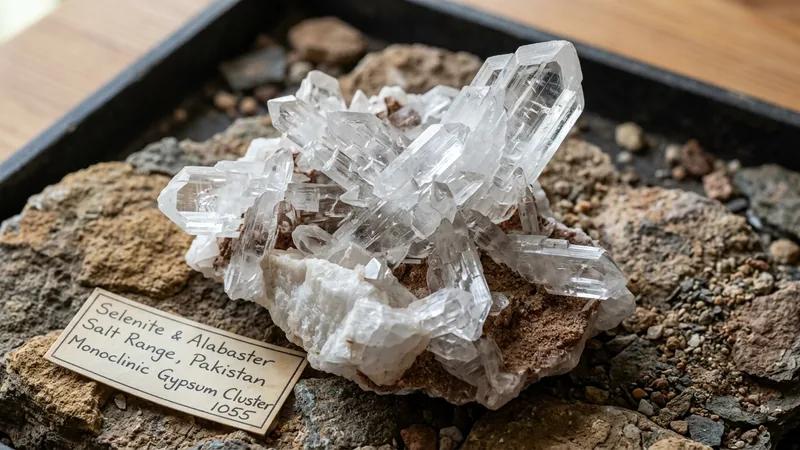
Mandatory Claim Boundary & Sourcing Notice: This page describes mineral/material evidence and buyer requirements. It does not represent current Enigma Earth inventory. Source, ownership, grade, quantity and availability must be verified for the specific enquiry.
Mineralogy & Geological Occurrence
Pakistan holds immense geological reserves of high-purity natural gypsum and associated anhydrite. Extensively distributed throughout Punjab, Khyber Pakhtunkhwa, Sindh, and Balochistan, the mineral forms the primary retarder for the national cement manufacturing industry, with high-whiteness deposits supplying plasterboard and agricultural soil conditioning.
The most extensive deposits occur in the Neoproterozoic Salt Range Formation (associated with halite sequences) and Eocene marine evaporite formations (such as the Bahadur Khel and Kohat gypsum formations). Massive sedimentary gypsum beds also outcrop along the Axial Fold Belt in Balochistan (Spintangi) and southern Indus basin strata in Sindh (Dadu and Thatta).
The primary commercial mineral is gypsum (CaSO4·2H2O, containing 20.9% chemically combined water). Anhydrite (CaSO4) naturally occurs interbedded in deeper horizons. Common accessory impurities include calcite, dolomite, clay minerals, quartz, and minor iron oxides.
Pakistan Evidence & Regional Context
Gypsum extraction is widespread and officially documented across all four provinces. The material is produced from open-cast quarries supplying domestic cement manufacturing plants and regional export terminals.
Salt Range (Mianwali, Dandot, Khewra, Daud Khel)
Pakistan's principal gypsum production belt, yielding high-purity massive white and crystalline gypsum utilized by major cement factories.
Kohat & Karak Basin (Bahadur Khel, Malgin)
Massive Eocene gypsum sequences with thicknesses exceeding 40 meters, quarried for cement, plaster, and agricultural soil rehabilitation.
Spintangi (Sibi) & Chamalang Belts
High-purity sedimentary gypsum beds accessible via railway and highway corridors, serving southern industrial centers.
Dadu, Thatta & Jamshoro Outcrops
Tertiary sedimentary gypsum beds providing raw material feed for southern Sindh cement and plaster industries.
Commercial Forms & Processing Stages
Commercial requirements must strictly differentiate between raw extraction, sorted grades, and processed products.
Cement-Grade Coarse Lumpy Gypsum
Screened raw gypsum rock crushed to size for intergrinding with Portland cement clinker (typically 3% to 5% by mass) to control initial hydration and flash setting.
High-Whiteness Plasterboard & Plaster Grade
Selective pure white alabaster gypsum free of iron staining, calcined into hemihydrate (plaster of Paris / CaSO4·0.5H2O) for gypsum board and dental plaster.
Agricultural Gypsum Soil Conditioner
Finely ground gypsum powder applied to sodic agricultural soils to displace harmful exchangeable sodium with soluble calcium and improve water infiltration.
Chemical Anhydrite
Anhydrous calcium sulfate (CaSO4) rock with zero structural water, utilized in specialized self-leveling floor screeds and chemical sulfuric acid manufacturing.
Buyer Specification Requirements
Prospective buyers and project owners should specify the parameters below. Values represent typical industrial targets and do not imply universal Pakistani deposit compliance.
Chemical Composition & Purity
5 ParametersInsolubles & Color Parameters
3 ParametersLogistics & Consignment Sizing
3 ParametersTesting & Verification Requirements
Testing and quality verification must be conducted by an appropriate independent laboratory. Commercial transactions require representative sampling, assay, chemical analysis or gemological appraisal, and third-party inspection. Enigma Earth does not maintain a private testing monopoly.
Bulk mechanical sampling from conveyor transfer chutes or stratified stockpile increment collection according to ASTM C50 / ISO 3082 standards. Analytical sample preparation by jaw crushing and pulverization.
- ASTM C22 / C22M (Standard Specification for Gypsum)
- ASTM C471M (Standard Test Methods for Chemical Analysis of Gypsum and Gypsum Products)
- ISO 6331 (Determination of calcium, magnesium and sulfate content)
- EN 196-2 (Methods of testing cement — Chemical analysis of cement and sulfate)
Testing must explicitly differentiate gypsum dihydrate from hemihydrate and anhydrite. Independent laboratories (such as ALS or SGS) provide comprehensive analysis including volatile chlorides.
Impurity Tolerances & Critical Penalty Factors
Commercial specifications require explicit thresholds for penalty elements, structural soundness, color uniformity, and treatment parameters.
Water-Soluble Chlorides (Cl- > 0.05%)
Quality ParameterOperational Impact: Severe corrosion risk to steel reinforcement bars in concrete structures
Excess Free Moisture (> 3.0%)
Quality ParameterOperational Impact: Causes adhesive caking, bunker blockages, and feed chute choking in crushing circuits and cement grinding mills
Free Silica / Quartz (> 4.0%)
Quality ParameterOperational Impact: Causes abrasive wear on vertical roller mills, ball mill liners, and crushing jaw plates
High Anhydrite Fraction (> 15% in plaster feed)
Quality ParameterOperational Impact: Alters calcination temperature profiles and retards initial hydration setting times in plasterboard manufacturing
Sourcing, Provenance & Preparation Logistics
Due diligence guidelines for legal chain of custody, packaging standards, and maritime export protocols.
Commercial gypsum shipments require provincial mining dispatch challans, royalty payment clearance receipts, and weighbridge certificates from registered quarry concessions.
Quarries operate under provincial Mines & Minerals departments. Sourcing must verify environmental compliance, particularly dust mitigation and sustainable pit rehabilitation.
- Unpacked loose bulk cargo loaded into dump trucks, open rail wagons, or bulk carrier vessel holds
- 1.0 MT to 1.5 MT heavy-duty woven polypropylene bulk bags for containerized export
- 50 kg multi-wall bags for agricultural and plaster applications
Direct rail haulage or flatbed trucking to national industrial consumers, or direct conveyance to Port Qasim for export bulk vessel loading.
Relevant Regional Context
Dominant commercial supplier hosting extensive Salt Range deposits (Mianwali, Dandot, Daud Khel).
Massive Eocene gypsum sequences in the Kohat and Karak districts.
Spintangi and Chamalang deposits servicing southern Pakistan and marine export markets.
Dadu and Thatta deposits supporting southern cement manufacturing clusters.
Related Minerals & Materials
Technical Support for Industrial Mineral Requirements
Enigma Earth provides technical due diligence, commercial facilitation, and exploration services to de-risk mineral procurement in Pakistan.
Mineral Trading & Bulk Logistics
Charter vessel stevedoring, draft surveys, bulk weighbridge control, and supply contract management.
Mineral Exploration & Quality Audits
Stratigraphic seam mapping, core logging, chemical profiling, and quarry reserve calculation.
Mining Consultancy & Processing Advisory
Open-pit mine planning, crushing and screening plant design, and environmental permitting.
Commercial Pathways for Gypsum & Anhydrite
Whether you are an international buyer seeking verified mineral supply or a licensed Pakistani mine operator looking to qualify off-take.
Mineral Buyers Registry
Review documented off-take requirements from industrial and international buyers.
Sell Your Mineral
Submit verifiable Gypsum & Anhydrite parcels, stockpiles, or concessions for third-party qualification.
Mining Tenders & Leases
Monitor provincial DGMM lease auctions, block bidding, and concession notices.
Pakistan Mining Regions
Explore provincial mineral directorates, logistics corridors, and geological belts across Pakistan.
What to Send: Technical Requirement Checklist
To evaluate feasibility and structure compliant off-take, please include the following technical details in your enquiry.
Frequently Asked Questions: Gypsum & Anhydrite
Key questions regarding Pakistani mineral availability, testing protocols, and trade qualification.
Gypsum acts as a vital set-retarding agent. Without gypsum, tricalcium aluminate (C3A) in the clinker hydrates instantly upon contact with water, causing instantaneous 'flash set'. Gypsum reacts with C3A to form ettringite, controlling the setting time to allow concrete placement and finishing.
Structure a Compliant Gypsum & Anhydrite Requirement
Submit required purity, moisture limits, and consignment tonnages for structured commercial review.