
Manganese Ore Context & Buyer Requirements in Pakistan
Manganese ore occurrences in Pakistan are primarily associated with volcanogenic-sedimentary horizons intercalated within ophiolite complexes. Commercial utilization depends on verified Mn grade, the Mn:Fe ratio, phosphorus limits, and physical sizing.
Mandatory Claim Boundary & Sourcing Notice: This page describes mineral/material evidence and buyer requirements. It does not represent current Enigma Earth inventory. Source, ownership, grade, quantity and availability must be verified for the specific enquiry.
Mineralogy & Geological Occurrence
Manganese deposits in Pakistan occur predominantly as stratabound lenses and podiform bodies within the volcanic-sedimentary sections of ophiolite belts in Balochistan and Khyber Pakhtunkhwa. Mineralization is typical of submarine exhalative systems associated with pillow basalts and radiolarian cherts.
The primary manganese occurrences lie within the Bela Ophiolite Belt in Lasbela District, Balochistan, and the Kurram-Waziristan ophiolitic sequences in KP. These deposits represent Cretaceous ocean-floor volcanogenic-sedimentary accumulations subsequently obducted onto continental margins.
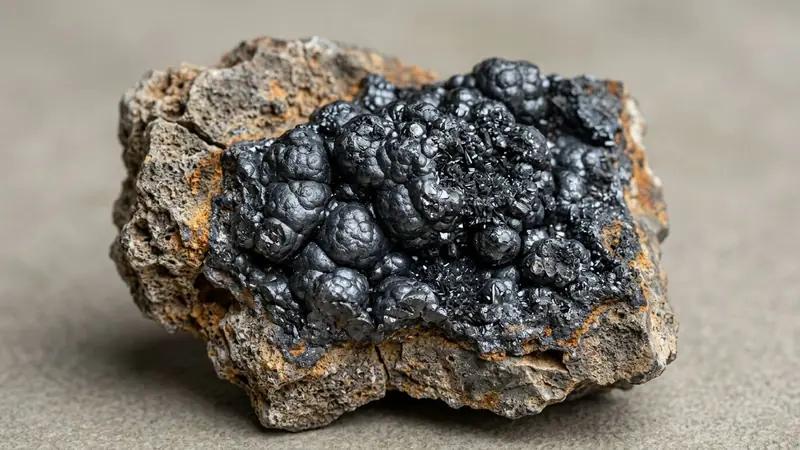
Mineralogy is dominated by manganese oxides, principally pyrolusite (MnO2) and cryptomelane/psilomelane, with minor manganese carbonate (rhodochrosite) and silicate phases (braunite, rhodonite) at deeper stratigraphic levels.
Pakistan Evidence & Regional Context
Manganese extraction in Pakistan is documented through positive official reporting and active private quarrying in the Bela ophiolite belt. Occurrences are typically discontinuous and lenticular, requiring systematic sampling rather than assumed continuous deposit geometry.
Lasbela (Bela Ophiolite: Kharari Nai, Sanjro, Siro Dhoro)
Volcanogenic-sedimentary exhalative lenses in basalt-chert sequences. Extracted via selective opencast pits; grade varies significantly across individual lenses.
Kurram Agency & North Waziristan Ophiolitic Belts
Hydrothermal and sedimentary manganese horizons within suture zone volcanic rocks; exploration and artisanal extraction status.
Commercial Forms & Processing Stages
Commercial requirements must strictly differentiate between raw extraction, sorted grades, and processed products.
Metallurgical Lumpy Manganese Ore
Screened lump ore suitable for electric arc furnace charge in ferromanganese and silicomanganese production. Requires minimum physical strength to withstand furnace burden.
Manganese Fines / Sinter Feed
Fine ore particles generated during crushing or extraction. Requires agglomeration or sintering prior to blast furnace or ferroalloy smelting.
Chemical & Battery Grade Ore
High-purity manganese dioxide (MnO2 >= 75%) with low iron and heavy metal content, evaluated for chemical synthesis and dry-cell battery cathode materials.
Buyer Specification Requirements
Prospective buyers and project owners should specify the parameters below. Values represent typical industrial targets and do not imply universal Pakistani deposit compliance.
Assay & Elemental Composition
6 ParametersPhysical & Moisture Parameters
2 ParametersCommercial & Lot Parameters
3 ParametersTesting & Verification Requirements
Testing and quality verification must be conducted by an appropriate independent laboratory. Commercial transactions require representative sampling, assay, chemical analysis or gemological appraisal, and third-party inspection. Enigma Earth does not maintain a private testing monopoly.
Manual increment sampling of static stockpiles or stream sampling during container stuffing in accordance with ISO 4296-1 and ISO 4296-2. Preparation of representative moisture and analytical sample splits.
- ISO 4297 (Manganese ores and concentrates — Determination of manganese content — Potentiometric method)
- ISO 312 (Determination of active oxygen as manganese dioxide content)
- ASTM E314 (Standard Test Methods for Chemical Analysis of Manganese in Ore)
All commercial contracting requires independent laboratory verification. Enigma Earth does not maintain a private assay monopoly; testing must be performed by mutually agreed accredited laboratories.
Manganese Grade, Impurities & Penalty Factors
Commercial specifications require explicit thresholds for penalty elements, structural soundness, color uniformity, and treatment parameters.
Manganese Grade (Mn)
Quality ParameterOperational Impact: Commercial pricing and metallurgical recovery depend on verified lot grade; grades vary across lenticular ophiolitic occurrences requiring representative testing
Iron Content & Mn:Fe Ratio
Quality ParameterOperational Impact: Determines whether ore can produce standard high-carbon ferromanganese (typically requiring Mn:Fe >= 6:1) versus silicomanganese (tolerates Mn:Fe 4:1 to 5:1) or blast furnace charge
Silica (SiO2) & Alumina (Al2O3)
Quality ParameterOperational Impact: Governs slag melting temperature, volume, and operational fluidity in submerged electric arc smelting furnaces
Phosphorus (P)
Quality ParameterOperational Impact: Phosphorus reduces completely into ferroalloys and induces cold-shortness (embrittlement) in finished steel
Sulphur (S)
Quality ParameterOperational Impact: Volatilizes during smelting and transfers into molten metal or off-gas streams, increasing steelmaking desulfurization load
Moisture Content (Free Moisture)
Quality ParameterOperational Impact: Excess free water inflates freight deadweight, causes material handling stickiness, and consumes unnecessary thermal energy in furnaces
Size Distribution (< 6.3 mm Fines vs Lump)
Quality ParameterOperational Impact: Excess fines impede furnace gas permeability, causing hazardous eruptions and erratic conductivity; lump ore must maintain physical strength
Sourcing, Provenance & Preparation Logistics
Due diligence guidelines for legal chain of custody, packaging standards, and maritime export protocols.
All manganese shipments must be accompanied by official provincial transport passes (DGMM), validated mining lease identifiers, and certified provenance documentation.
Concessions in Lasbela and Kurram operate under provincial mining regulatory regimes. Consignment dispatch requires verification of lease status and local royalty settlements.
- Bulk containerized transport inside 20ft shipping containers with protective front bulkheads
- 1.25 MT heavy-duty polypropylene woven jumbo bags with lifting loops
Trucking from Lasbela or KP aggregation yards to Port Qasim or Karachi Port for containerized or breakbulk vessel loading.
Relevant Regional Context
Technical Support for Mineral Evaluation & Supply
Enigma Earth provides technical due diligence, commercial facilitation, and exploration services to de-risk mineral procurement in Pakistan.
Mineral Trading & Export Facilitation
Independent off-take structuring, lot identification, export clearance, and port logistics management.
Mineral Exploration & Resource Appraisal
Geological mapping, geochemical trenching, core drilling, and JORC-compliant resource appraisal for metallic assets.
Mining Consultancy & Concession Diligence
Provincial lease title verification, technical audits, and regulatory compliance advisory.
Commercial Pathways for Manganese Ore
Whether you are an international buyer seeking verified mineral supply or a licensed Pakistani mine operator looking to qualify off-take.
Mineral Buyers Registry
Review documented off-take requirements from industrial and international buyers.
Sell Your Mineral
Submit verifiable Manganese Ore parcels, stockpiles, or concessions for third-party qualification.
Mining Tenders & Leases
Monitor provincial DGMM lease auctions, block bidding, and concession notices.
Pakistan Mining Regions
Explore provincial mineral directorates, logistics corridors, and geological belts across Pakistan.
What to Send: Technical Requirement Checklist
To evaluate feasibility and structure compliant off-take, please include the following technical details in your enquiry.
Frequently Asked Questions: Manganese Ore
Key questions regarding Pakistani mineral availability, testing protocols, and trade qualification.
During ferroalloy smelting, virtually 100% of phosphorus passes into the ferromanganese or silicomanganese alloy and subsequently into the steel, causing severe brittleness (cold shortness). Ores with phosphorus above 0.12% face steep discounts, and above 0.18% are often rejected.
Structure a Compliant Manganese Ore Requirement
Submit technical specifications, target grades, and consignment parameters for structured verification.