
Bentonite Mineral Context & Buyer Requirements in Pakistan
Bentonite deposits in Pakistan occur primarily as altered volcanic ash beds within the Neogene Siwalik Group. Natural occurrences are predominantly calcium-type smectites; achieving high-swelling API drilling fluid or foundry bonding performance requires technical evaluation and controlled activation.
Mandatory Claim Boundary & Sourcing Notice: This page describes mineral/material evidence and buyer requirements. It does not represent current Enigma Earth inventory. Source, ownership, grade, quantity and availability must be verified for the specific enquiry.
Mineralogy & Geological Occurrence
Pakistan possesses significant bentonite clay resources formed by the in-situ weathering and devitrification of volcanic ash tuffs deposited in lacustrine and floodplain environments. Deposits supply domestic iron ore pelletizing, civil engineering trenching, foundry sand bonding, and oilfield drilling muds.
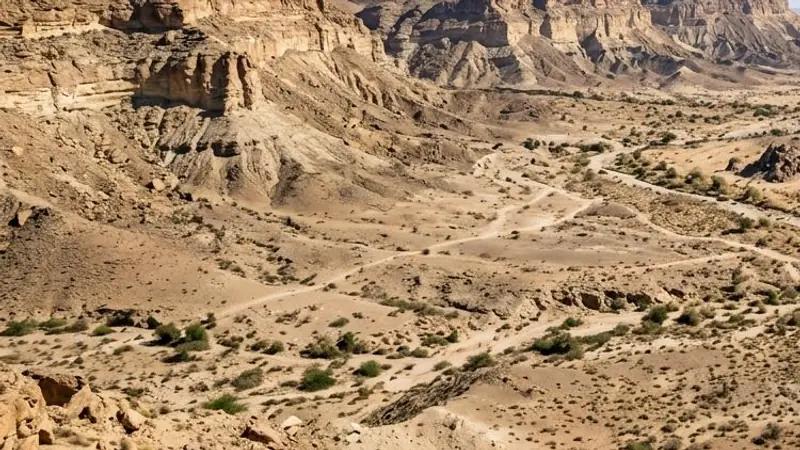
The primary bentonite horizons occur in the upper part of the Miocene-Pliocene Siwalik Group, extending across Jhelum District in northern Punjab and into the Mirpur and Bhimber districts of Azad Jammu & Kashmir. Horizons occur as persistent strata ranging from 0.3 m to over 2 m in thickness.
The dominant active mineral phase is montmorillonite (dioctahedral smectite), characterized by an expandable 2:1 layer structure that accommodates water molecules and exchangeable cations. Natural Pakistani deposits are predominantly calcium-bentonites, which exhibit moderate swelling compared to natural Wyoming sodium-bentonites.
Pakistan Evidence & Regional Context
Bentonite extraction in Pakistan is documented through positive official reporting and commercial operations in Punjab and AJK. Local processing mills perform drying, milling, and sodium activation (addition of sodium carbonate / soda ash) to enhance rheological performance.
Jhelum (Dina, Rohtas, Sohawa Siwalik horizons)
Bedded volcanic ash bentonite seams up to 1.5 m thick. Extracted via opencast quarrying; established supply for domestic foundries and activated drilling products.
Mirpur & Bhimber (Samwal, Chitti Dheri, Kas Gum)
High-grade montmorillonite clay seams along the Himalayan foothills; actively extracted for regional industrial processors.
Khairpur & D.G. Khan (Fuller's earth & bleaching clay deposits)
Acid-activatable bleaching clays utilized in vegetable oil refining and industrial effluent decolorization.
Commercial Forms & Processing Stages
Commercial requirements must strictly differentiate between raw extraction, sorted grades, and processed products.
API Drilling Grade Bentonite
Sodium-activated and beneficiated bentonite powder meeting API Specification 13A Section 9 requirements (viscometer 600 rpm dial reading >= 30, filtrate volume <= 16.0 cm3).
Foundry Grade Bentonite
High-green-strength and dry-compression-strength bonding clay used to bind quartz sands in high-pressure green sand metal casting molds.
Civil Engineering & Piling Bentonite
Thixotropic slurry bentonite for diaphragm wall excavation, continuous slurry trenching, horizontal directional drilling (HDD), and tunnel boring machines.
Crude Natural Clay Lump
Unprocessed, pit-moist calcium bentonite lump supplied directly from quarries for custom industrial processing, cat litter, or agricultural conditioning.
Buyer Specification Requirements
Prospective buyers and project owners should specify the parameters below. Values represent typical industrial targets and do not imply universal Pakistani deposit compliance.
Rheological & Physical Parameters
6 ParametersPurity & Particle Sizing
3 ParametersCommercial & Delivery Parameters
3 ParametersTesting & Verification Requirements
Testing and quality verification must be conducted by an appropriate independent laboratory. Commercial transactions require representative sampling, assay, chemical analysis or gemological appraisal, and third-party inspection. Enigma Earth does not maintain a private testing monopoly.
Automated stream sampling of milled powder or increment bag sampling in compliance with API Specification 13A / ISO 13500. Splitting into sealed airtight testing containers to preserve moisture integrity.
- API Specification 13A / ISO 13500 (Drilling Fluid Materials — Section 9: Bentonite)
- ASTM D5890 (Standard Test Method for Swell Index of Clay Mineral Component of Geosynthetic Clay Liners)
- ASTM D422 (Particle Size Analysis of Soils / Clays via Hydrometer)
Do not claim API compliance automatically. Buyers requiring API 13A drilling mud must specify third-party test certificates documenting 600 rpm reading, yield point, fluid loss, and wet screen residue for the specific consignment.
Impurity Tolerances & Critical Penalty Factors
Commercial specifications require explicit thresholds for penalty elements, structural soundness, color uniformity, and treatment parameters.
Incomplete Sodium Activation
Quality ParameterOperational Impact: Under-activated calcium bentonite fails to develop necessary electrostatic repulsion, yielding low viscosity and excessive fluid loss into permeable rock formations
Abrasive Quartz / Grit Content (> 75 µm)
Quality ParameterOperational Impact: Coarse silica sand grit causes rapid erosion of drilling mud pumps, drill collars, and slurry recycling hydrocyclones
Over-Drying and Lattice Collapse
Quality ParameterOperational Impact: Drying raw bentonite at temperatures > 120°C drives off constitutional hydroxyl water, collapsing interlayer platelets and destroying rehydration swelling
Gypsum and Carbonate Contamination
Quality ParameterOperational Impact: Excess soluble calcium from gypsum inhibits sodium exchange and destabilizes polymer-treated mud systems
Sourcing, Provenance & Preparation Logistics
Due diligence guidelines for legal chain of custody, packaging standards, and maritime export protocols.
All consignments must be accompanied by official provincial transport passes from Punjab or AJK mining directorates, verified lease identifiers, and processing mill batch records.
Quarries in Jhelum, Mirpur, and Bhimber operate under provincial mining lease regulations. Processing facilities must maintain environmental dust containment and waste reclamation.
- 50 kg multi-wall paper bags with inner polyethylene barrier on heat-treated shrink-wrapped pallets
- 1.0 MT heavy-duty UV-stabilized woven polypropylene bulk jumbo bags with lifting loops
Road haulage from Punjab/AJK milling facilities to local industrial sites or to Karachi Port for containerized maritime export.
Relevant Regional Context
Related Minerals & Materials
Technical Support for Industrial Mineral Requirements
Enigma Earth provides technical due diligence, commercial facilitation, and exploration services to de-risk mineral procurement in Pakistan.
Mineral Trading & Export Facilitation
Independent off-take structuring, lot identification, export clearance, and port logistics management.
Mineral Exploration & Resource Appraisal
Geological mapping, seam thickness modeling, and clay quality evaluation for bentonite deposits.
Mining Consultancy & Concession Diligence
Provincial lease title verification, technical audits, and regulatory compliance advisory.
Commercial Pathways for Bentonite & Specialty Clays
Whether you are an international buyer seeking verified mineral supply or a licensed Pakistani mine operator looking to qualify off-take.
Mineral Buyers Registry
Review documented off-take requirements from industrial and international buyers.
Sell Your Mineral
Submit verifiable Bentonite & Specialty Clays parcels, stockpiles, or concessions for third-party qualification.
Mining Tenders & Leases
Monitor provincial DGMM lease auctions, block bidding, and concession notices.
Pakistan Mining Regions
Explore provincial mineral directorates, logistics corridors, and geological belts across Pakistan.
What to Send: Technical Requirement Checklist
To evaluate feasibility and structure compliant off-take, please include the following technical details in your enquiry.
Frequently Asked Questions: Bentonite & Specialty Clays
Key questions regarding Pakistani mineral availability, testing protocols, and trade qualification.
No. Natural in-situ bentonite in Pakistan is predominantly a calcium-smectite with moderate swelling (8 - 14 ml/2g). Achieving high swelling (> 24 ml/2g) and API drilling fluid viscosity requires controlled sodium activation (pugging with soda ash and controlled curing) during industrial milling.
Structure a Compliant Bentonite & Specialty Clays Requirement
Submit technical specifications, target rheological parameters, and consignment requirements for structured verification.