
Talc & Soapstone Mineral Context in Pakistan
Talc and soapstone sourcing in Pakistan demands rigorous evaluation of mineralogical purity, optical brightness, acid-soluble impurities, and particle morphology. Do not claim asbestos-free, cosmetic grade, pharmaceutical grade, or food grade without lot-specific testing and appropriate accredited standards.
Mandatory Claim Boundary & Sourcing Notice: This page describes mineral/material evidence and buyer requirements. It does not represent current Enigma Earth inventory. Source, ownership, grade, quantity and availability must be verified for the specific enquiry.
Mineralogy & Geological Occurrence
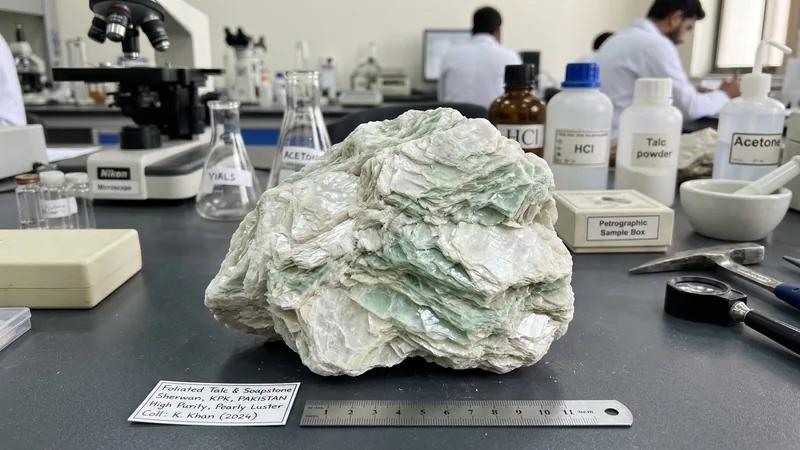
Pakistan produces substantial volumes of industrial-grade talc and steatite (soapstone), prized for its exceptional softness (Mohs hardness 1), chemical inertness, high thermal resistance, and electrical insulation. Commercial grades range from high-brightness sorted lumps to micronized functional fillers across diverse manufacturing sectors.
The preeminent talc province is situated in the Hazara region of Khyber Pakhtunkhwa, centered on the Sherwan deposit near Abbottabad. Mineralization is hosted within Precambrian dolomites and magnesites of the Abbottabad Formation, formed by hydrothermal metasomatism associated with regional granitic intrusions. Secondary occurrences are documented in Kurram, Swat, and Zhob ophiolite suture zones.
Pure talc consists of Mg3Si4O10(OH)2. Commercial soapstone naturally contains accessory carbonates (magnesite, dolomite, calcite), chlorite, tremolite, and quartz. Lot-specific mineralogical analysis (XRD) determines exact phase proportions.
Pakistan Evidence & Regional Context
Talc is actively quarried in Khyber Pakhtunkhwa through established underground and open-pit concessions, supplying domestic grinding mills, ceramic producers, and international export channels.
Sherwan (Abbottabad), Kurram, and Swabi Belts
Sherwan is Pakistan's premier commercial talc center, producing high-whiteness foliated steatite; Kurram and Swabi host hydrothermal and ophiolite-associated soapstone bodies.
Zhob & Muslim Bagh Ophiolitic Ultramafics
Serpentinite-altered hydrothermal soapstone occurrences; primarily industrial grade with higher iron and chlorite contents.
Commercial Forms & Processing Stages
Commercial requirements must strictly differentiate between raw extraction, sorted grades, and processed products.
Hand-Sorted Lump Soapstone (Grade A White)
Selective hand-cobbed raw rock free of visible iron oxide staining and quartz veins, exhibiting high natural brightness. Shipped in bulk to overseas processing plants.
Commercial Industrial Lump (Grade B / C)
Medium-grade grey-white or greenish soapstone rock containing minor chlorite or dolomite inclusions, utilized in ceramics, foundry coatings, and filler manufacturing.
Micronized Functional Talc Powder
Fine air-classified talc powder with controlled top-cut particle size distribution, utilized as an anti-blocking agent in plastics and pitch-control additive in paper.
Ceramic & Refractory Steatite
Dense steatite rock with low iron and fluxing alkalis, crushed and milled for electrical insulator porcelain and thermal shock refractory bodies.
Buyer Specification Requirements
Prospective buyers and project owners should specify the parameters below. Values represent typical industrial targets and do not imply universal Pakistani deposit compliance.
Chemical Composition & Mineralogy
5 ParametersOptical & Physical Properties
4 ParametersCompliance & Safety Verification
3 ParametersTesting & Verification Requirements
Testing and quality verification must be conducted by an appropriate independent laboratory. Commercial transactions require representative sampling, assay, chemical analysis or gemological appraisal, and third-party inspection. Enigma Earth does not maintain a private testing monopoly.
Representative sampling of milled batches or stratified increment sampling of sorted lump stockpiles according to ISO 8213 guidelines. Sample pulverization and homogenized analytical splitting.
- ISO 3262-10 (Extenders for paints — Part 10: Natural talc/chlorite in lamellar form)
- ISO 13320 (Particle size analysis — Laser diffraction methods)
- ISO 2470 (Paper, board and pulps — Measurement of diffuse blue reflectance factor / ISO brightness)
- ASTM D717 (Standard Test Methods for Analysis of Barium Sulfate and Extender Pigments)
- NIOSH 9002 / EPA 600 (Polarized Light Microscopy / Transmission Electron Microscopy for asbestos screening)
All commercial grade designations, whiteness values, and safety certifications must be authenticated by recognized third-party laboratories. Enigma Earth does not make unilateral purity or safety declarations without accredited laboratory test reports.
Impurity Tolerances & Critical Penalty Factors
Commercial specifications require explicit thresholds for penalty elements, structural soundness, color uniformity, and treatment parameters.
Asbestiform Amphibole Contamination (Tremolite / Anthophyllite)
Quality ParameterOperational Impact: Severe carcinogenic hazard; strictly banned in international consumer goods, cosmetics, and paints
Iron Oxide Staining (Fe2O3 > 1.5%)
Quality ParameterOperational Impact: Imparts yellowish or grey tint, reducing whiteness and causing thermal discoloration in ceramic firing
Free Quartz / Silica (> 3.0%)
Quality ParameterOperational Impact: Increases abrasive wear on processing machinery (extrusion dies, paper wires, printing plates)
Carbonate Gangue (Calcite / Dolomite > 3.0%)
Quality ParameterOperational Impact: Elevates acid reactivity (acid-soluble matter) and disrupts pH stability in chemical formulations
Sourcing, Provenance & Preparation Logistics
Due diligence guidelines for legal chain of custody, packaging standards, and maritime export protocols.
All talc consignments require valid provincial transport passes issued by the Directorate General of Mines & Minerals KP, verified mining lease numbers, and authorized mill processing logs.
The Sherwan talc belt comprises multiple private mining leases. Procurement requires rigorous verification of lease validity, royalty payments, and local environmental compliance.
- 25 kg multi-wall valve paper bags with inner plastic barrier film, palletized and stretch-wrapped
- 1.0 MT to 1.2 MT UV-treated woven polypropylene bulk big bags with dust-proof seams
- Unpacked bulk containers for raw lump consignments loaded via front-end loaders with protective liners
Road haulage via Motorway M-1 / M-2 to Karachi Port or Port Qasim for export containerization. 20ft marine containers are standard for milled powder consignments.
Relevant Regional Context
Related Minerals & Materials
Technical Support for Industrial Mineral Requirements
Enigma Earth provides technical due diligence, commercial facilitation, and exploration services to de-risk mineral procurement in Pakistan.
Mineral Trading & Export Facilitation
Lump inspection, milling oversight, whiteness certification, and containerized freight management.
Mineral Exploration & Deposit Evaluation
Structural mapping of dolomitic steatite horizons, core drilling, and reserve estimation.
Mining Consultancy & Quality Systems
Selective mining optimization, beneficiation flow-sheet design, and provincial lease diligence.
Commercial Pathways for Talc & Soapstone (Steatite)
Whether you are an international buyer seeking verified mineral supply or a licensed Pakistani mine operator looking to qualify off-take.
Mineral Buyers Registry
Review documented off-take requirements from industrial and international buyers.
Sell Your Mineral
Submit verifiable Talc & Soapstone (Steatite) parcels, stockpiles, or concessions for third-party qualification.
Mining Tenders & Leases
Monitor provincial DGMM lease auctions, block bidding, and concession notices.
Pakistan Mining Regions
Explore provincial mineral directorates, logistics corridors, and geological belts across Pakistan.
What to Send: Technical Requirement Checklist
To evaluate feasibility and structure compliant off-take, please include the following technical details in your enquiry.
Frequently Asked Questions: Talc & Soapstone (Steatite)
Key questions regarding Pakistani mineral availability, testing protocols, and trade qualification.
No. Cosmetic and pharmaceutical applications require strict compliance with pharmacopeial standards (such as USP-NF or Ph. Eur.), including rigorous, lot-by-lot XRD and TEM verification proving the absence of asbestiform amphiboles. Most commercial extraction serves industrial applications such as ceramics, paints, and plastics unless specialized testing is performed.
Structure a Compliant Talc & Soapstone (Steatite) Requirement
Submit required mesh size, whiteness targets, and consignment parameters for expert technical review.