
Iron Ore, Hematite & Magnetite Context in Pakistan
Iron ore requirements in Pakistan require technical differentiation between high-grade magnetite skarns, sedimentary oolitic ironstones, and beneficiated concentrates. Resource evidence does not automatically establish mineability, beneficiation performance, saleable product or economic viability.
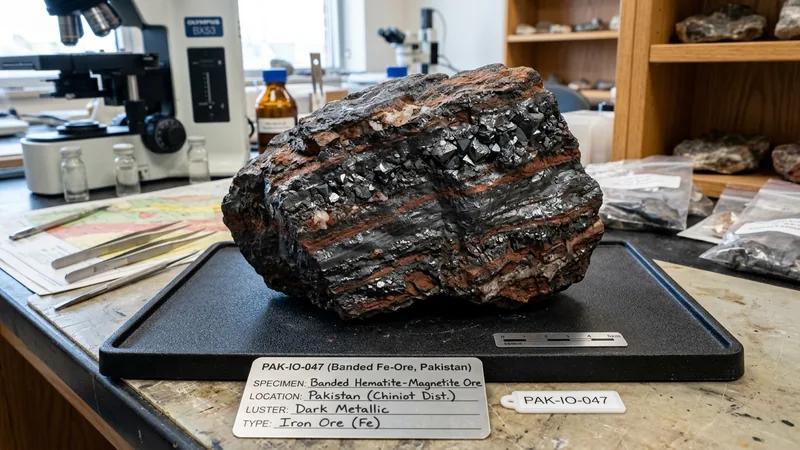
Mandatory Claim Boundary & Sourcing Notice: This page describes mineral/material evidence and buyer requirements. It does not represent current Enigma Earth inventory. Source, ownership, grade, quantity and availability must be verified for the specific enquiry.
Mineralogy & Geological Occurrence
Pakistan contains diverse iron mineral occurrences distributed across three distinct geological categories: volcanogenic/skarn contact metasomatic magnetite-hematite deposits, sedimentary oolitic ironstones, and hydrothermal vein replacements. Commercial utilization is dictated by iron grade (Fe %), silica-alumina gangue ratios, and metallurgical reducibility.
Major iron deposits occur in the Kirana Hills inlier of Punjab (subsurface Precambrian banded iron formation / skarn at Chiniot-Rajoa), the Mesozoic sedimentary sequences of the Salt Range and Trans-Indus ranges (Kalabagh oolitic ironstone), the Chagai arc of Balochistan (Pachinkoh and Chigendik magnetite skarns), and sedimentary-lateritic beds at Dilband.
High-grade skarn ores are dominated by massive magnetite (Fe3O4) with subordinate specular hematite. Sedimentary formations are primarily composed of chamosite, greenalite, oolitic hematite, and limonite with high cryptocrystalline quartz and phosphate gangue.
Pakistan Evidence & Regional Context
Iron ore extraction and exploration in Pakistan are documented across provincial records. While domestic production feeds local steel re-rolling and cement manufacturing, large-scale blast furnace utilization has historically been constrained by beneficiation complexities in sedimentary ores.
Chiniot-Rajoa & Kalabagh (Mianwali)
Chiniot-Rajoa hosts deep subsurface magnetite-rich iron mineralization explored by provincial authorities; Kalabagh represents extensive oolitic sedimentary ironstone with metallurgical beneficiation requirements.
Chagai Magmatic Arc (Pachinkoh, Chigendik) & Dilband (Mastung)
Pachinkoh and Chigendik feature contact metasomatic magnetite lenses; Dilband represents a sedimentary lateritic iron deposit with high phosphorus content.
Abbottabad (Langrial) & Hazara Belts
Sedimentary iron formations and ferruginous quartzites; primarily characterized as exploration occurrences requiring extensive gangue separation.
Commercial Forms & Processing Stages
Commercial requirements must strictly differentiate between raw extraction, sorted grades, and processed products.
Magnetite Lumpy Ore
Dense, magnetic iron ore extracted from skarn or magmatic contact deposits. Suitable for direct reduction (DRI) or blast furnace blending after sizing.
Hematite Natural Fines
Naturally occurring friable hematite fines generated during quarrying and screening. Requires sintering or pelletizing prior to blast furnace charging.
Beneficiated Magnetic Concentrate
Finely milled iron concentrate produced via wet magnetic separation or gravity separation. Primary feedstock for pellet production plants.
Cement-Grade Ferruginous Material
Lower-grade iron ore or laterite utilized by cement manufacturing kilns to adjust iron modulus (Al2O3 / Fe2O3 ratio) in clinker production.
Buyer Specification Requirements
Prospective buyers and project owners should specify the parameters below. Values represent typical industrial targets and do not imply universal Pakistani deposit compliance.
Chemical Assay Parameters
6 ParametersPhysical & Moisture Parameters
3 ParametersCommercial & Consignment Parameters
3 ParametersTesting & Verification Requirements
Testing and quality verification must be conducted by an appropriate independent laboratory. Commercial transactions require representative sampling, assay, chemical analysis or gemological appraisal, and third-party inspection. Enigma Earth does not maintain a private testing monopoly.
Mechanical sampling from belt conveyors or systematic stopped-belt sampling according to ISO 3082. Static stockpile sampling must follow rigorous multi-point grid increments to prevent segregation bias.
- ISO 3082 (Iron ores — Sampling and sample preparation procedures)
- ISO 2597-1 (Determination of total iron content — Titrimetric method)
- ISO 9516-1 (Determination of various elements by X-ray fluorescence spectrometry)
- ISO 4701 (Determination of size distribution by sieving)
Accredited third-party assay (such as ALS, SGS, or Alfred H Knight) is mandatory. Assays must explicitly report FeO content to confirm magnetite versus hematite proportion.
Impurity Tolerances & Critical Penalty Factors
Commercial specifications require explicit thresholds for penalty elements, structural soundness, color uniformity, and treatment parameters.
High Silica (SiO2)
Quality ParameterOperational Impact: Increases slag volume, elevates limestone flux consumption, and increases energy costs in blast furnaces
Phosphorus (P)
Quality ParameterOperational Impact: Segregates to pig iron; causes cold shortness and structural embrittlement in final steel products
Alumina (Al2O3)
Quality ParameterOperational Impact: Increases slag viscosity, requiring higher furnace operating temperatures and excessive coke rate
Titanium (TiO2)
Quality ParameterOperational Impact: Forms viscous titanium carbonitrides in the blast furnace hearth, choking the tap hole
Alkalis (K2O + Na2O)
Quality ParameterOperational Impact: Circulate in blast furnace shaft, causing refractory degradation and coke degradation
Sourcing, Provenance & Preparation Logistics
Due diligence guidelines for legal chain of custody, packaging standards, and maritime export protocols.
Iron ore consignments must be traceable to authorized mining leases registered with provincial Mines and Minerals departments. Official dispatch receipts, transit challans, and weighbridge slips are required.
Several high-profile iron occurrences in Pakistan remain within exploration reservations or disputed concession blocks. Sourcing is strictly restricted to active, legally permitted quarry operators.
- Unpacked bulk cargo in open-top marine dump trucks or rail wagons
- 1.5 MT to 2.0 MT heavy-duty bulk bags for containerized export consignments
Overland haulage via national highway networks to local steel mills (Karachi, Lahore, Taxila) or bulk handling berths at Port Qasim for export parcels.
Relevant Regional Context
Related Minerals & Materials
Technical Support for Mineral Evaluation & Supply
Enigma Earth provides technical due diligence, commercial facilitation, and exploration services to de-risk mineral procurement in Pakistan.
Mineral Trading & Export Facilitation
Bulk lot sourcing, weighbridge supervision, sampling verification, and off-take contracts.
Mineral Exploration & Core Drilling
Magnetic anomaly ground truthing, wireline diamond drilling, and metallurgical test-work.
Mining Consultancy & Concession Audits
Mine planning, beneficiation flow-sheet design, and provincial lease compliance.
Commercial Pathways for Iron Ore (Hematite & Magnetite)
Whether you are an international buyer seeking verified mineral supply or a licensed Pakistani mine operator looking to qualify off-take.
Mineral Buyers Registry
Review documented off-take requirements from industrial and international buyers.
Sell Your Mineral
Submit verifiable Iron Ore (Hematite & Magnetite) parcels, stockpiles, or concessions for third-party qualification.
Mining Tenders & Leases
Monitor provincial DGMM lease auctions, block bidding, and concession notices.
Pakistan Mining Regions
Explore provincial mineral directorates, logistics corridors, and geological belts across Pakistan.
What to Send: Technical Requirement Checklist
To evaluate feasibility and structure compliant off-take, please include the following technical details in your enquiry.
Frequently Asked Questions: Iron Ore (Hematite & Magnetite)
Key questions regarding Pakistani mineral availability, testing protocols, and trade qualification.
High-grade magnetite lump (Fe > 60%) with low impurities can be blended directly. However, sedimentary ironstones (such as Kalabagh) contain complex chamositic and oolitic matrixes requiring specialized beneficiation and gangue reduction before blast furnace use.
Structure a Compliant Iron Ore (Hematite & Magnetite) Requirement
Submit technical specifications, target Fe grades, and delivery terms for comprehensive evaluation.