
Barite Mineral Context & Buyer Requirements in Pakistan
Barite sourcing in Pakistan requires precise technical qualification based on specific gravity (SG), barium sulfate (BaSO4) purity, water-soluble alkaline earths, and particle size distribution. Buyer-specified oilfield requirements may reference applicable API specifications and should be demonstrated for the specific material.
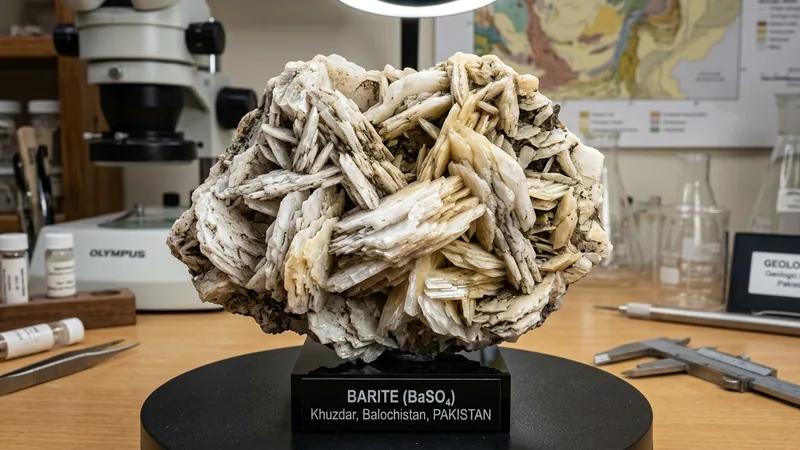
Mandatory Claim Boundary & Sourcing Notice: This page describes mineral/material evidence and buyer requirements. It does not represent current Enigma Earth inventory. Source, ownership, grade, quantity and availability must be verified for the specific enquiry.
Mineralogy & Geological Occurrence
Pakistan hosts extensive stratabound and hydrothermal vein barite deposits, principally located in the southern Axial Fold Belt of Balochistan. Recognized for high specific gravity and chemical inertness, Pakistani barite is primarily processed into weighting agents for oil and gas drilling fluids, with selected white grades utilized in paints, plastics, and friction materials.
The preeminent barite province is the Khuzdar-Lasbela metallogenic belt in Balochistan, where stratiform and replacement deposits (such as Gunga, Shekran, and Duddar) occur within the Jurassic Shirinab Formation. Additional hydrothermal vein occurrences cut calcareous formations in Khyber Pakhtunkhwa (Haripur and Kohistan).
The ore is dominated by barium sulfate (BaSO4), occurring as massive crystalline aggregates, tabular crystals, or fine-grained stratiform lenses. Associated minerals include quartz, calcite, fluorite, strontianite, and minor iron sulfides.
Pakistan Evidence & Regional Context
Barite mining and milling are well established in Balochistan, supported by state-authorized joint venture milling operations and private concessions supplying domestic exploration projects and regional export markets.
Khuzdar (Gunga, Shekran, Malli) & Lasbela Belts
Hosts Pakistan's largest commercial barite deposits with operating underground and open-pit mines and dedicated grinding mills supplying drilling muds.
Haripur (Kacchi, Tipra) & Swabi Belts
Hydrothermal vein deposits yielding crystalline white barite; suitable for local industrial filler and chemical processing.
Commercial Forms & Processing Stages
Commercial requirements must strictly differentiate between raw extraction, sorted grades, and processed products.
Drilling-Grade Raw Lump Barite
High-density raw uncrushed or coarsely crushed barite rock extracted directly from the mine face, suitable for maritime export to international grinding mills.
Milled Oilfield Barite Powder (Drilling Mud Weighting)
Finely pulverized barite powder processed for drilling fluid applications. Buyer-specified oilfield requirements may reference applicable API specifications and should be demonstrated for the specific material.
Chemical & Filler Grade White Barite
Selective, high-brightness barite bleached or naturally free of iron oxide staining, used as an inert pigment and high-density filler in paints, plastics, and coatings.
Industrial Aggregate & Radiation Shielding
Coarse barite aggregate incorporated into high-density heavyweight concrete formulations for hospital radiological rooms and nuclear containment shielding.
Buyer Specification Requirements
Prospective buyers and project owners should specify the parameters below. Values represent typical industrial targets and do not imply universal Pakistani deposit compliance.
Density & Chemical Assay
5 ParametersParticle Size & Physical Properties
3 ParametersPackaging & Delivery Requirements
3 ParametersTesting & Verification Requirements
Testing and quality verification must be conducted by an appropriate independent laboratory. Commercial transactions require representative sampling, assay, chemical analysis or gemological appraisal, and third-party inspection. Enigma Earth does not maintain a private testing monopoly.
Systematic incremental sampling of stockpiles or flowing production streams in accordance with API Specification 13A / ISO 10414. Composite blending and analytical splits.
- API Specification 13A / ISO 13500 (Drilling Fluids Materials — Barite)
- ASTM D717 (Standard Test Methods for Analysis of Barium Sulfate Pigment)
- ASTM C188 (Standard Test Method for Density of Hydraulic Cement / Pycnometer SG)
Where oilfield buyers require API compliance, specific gravity, soluble alkaline earths, and sieve fractions must be certified per lot by accredited independent laboratories (such as ALS, SGS, or certified drilling fluids laboratories).
Impurity Tolerances & Critical Penalty Factors
Commercial specifications require explicit thresholds for penalty elements, structural soundness, color uniformity, and treatment parameters.
Low Specific Gravity (< 4.10 SG)
Quality ParameterOperational Impact: Fails international drilling mud weighting standards; requires excessive chemical volume to achieve required mud density
Water-Soluble Alkaline Earth Metals (> 250 ppm as Ca)
Quality ParameterOperational Impact: Causes drilling mud flocculation, uncontrollable viscosity increase, and severe fluid loss
Abrasive Quartz / Silica (> 6.0%)
Quality ParameterOperational Impact: Accelerates severe wear on drilling rig mud pumps, mud motors, and downhole directional drilling tools
Heavy Metals (Cadmium & Mercury)
Quality ParameterOperational Impact: Strict environmental regulations on offshore ocean mud discharge (EPA / OSPAR limits)
Sourcing, Provenance & Preparation Logistics
Due diligence guidelines for legal chain of custody, packaging standards, and maritime export protocols.
All commercial barite shipments must be documented with verified provincial lease origins, royalty clearance certificates, and official mill processing logs.
The Khuzdar barite deposits operate under formal provincial mining leases and public-private joint venture entities. Commercial procurement is strictly conducted with licensed leaseholders and authorized processing plants.
- 1.5 MT UV-stabilized heavy-duty woven polypropylene bulk bags with lifting loops and spout discharge
- 50 kg multi-wall craft paper valve bags on stretch-wrapped pallets
- Bulk breakbulk stowage in vessel holds for raw lump consignments
Direct highway trucking from Khuzdar processing mills via RCD Highway (N-25) to Port Qasim or Karachi Port, offering convenient access to Arabian Gulf and international maritime routes.
Relevant Regional Context
Related Minerals & Materials
Technical Support for Industrial Mineral Requirements
Enigma Earth provides technical due diligence, commercial facilitation, and exploration services to de-risk mineral procurement in Pakistan.
Mineral Trading & Export Facilitation
Dedicated lot consolidation, independent specific gravity certification, and containerized export handling.
Mineral Exploration & Reserve Audit
Geological modeling of stratabound barite horizons, trenching, and density logging.
Mining Consultancy & Mill Optimization
Grinding circuit flow-sheet design, classifier optimization, and provincial mining regulatory compliance.
Commercial Pathways for Barite (Baryte / Heavy Spar)
Whether you are an international buyer seeking verified mineral supply or a licensed Pakistani mine operator looking to qualify off-take.
Mineral Buyers Registry
Review documented off-take requirements from industrial and international buyers.
Sell Your Mineral
Submit verifiable Barite (Baryte / Heavy Spar) parcels, stockpiles, or concessions for third-party qualification.
Mining Tenders & Leases
Monitor provincial DGMM lease auctions, block bidding, and concession notices.
Pakistan Mining Regions
Explore provincial mineral directorates, logistics corridors, and geological belts across Pakistan.
What to Send: Technical Requirement Checklist
To evaluate feasibility and structure compliant off-take, please include the following technical details in your enquiry.
Frequently Asked Questions: Barite (Baryte / Heavy Spar)
Key questions regarding Pakistani mineral availability, testing protocols, and trade qualification.
Historically, API Specification 13A mandated a minimum specific gravity of 4.20 g/cm3. In response to global high-density reserve depletion, the API standard was expanded to include a 4.10 g/cm3 grade. Both grades require strict limits on water-soluble alkaline earths (< 250 ppm as Ca) and particle size distribution.
Structure a Compliant Barite (Baryte / Heavy Spar) Requirement
Submit required specific gravity, mesh sizing, and consignment tonnages for structured evaluation.