
Industrial Minerals of Pakistan
A comprehensive technical directory of non-metallic industrial minerals across Pakistan's sedimentary basins and metamorphic suites. Highlighting drilling barite, high-brightness talc, gypsum, magnesite, fluorite, phosphate, and specialty clays.
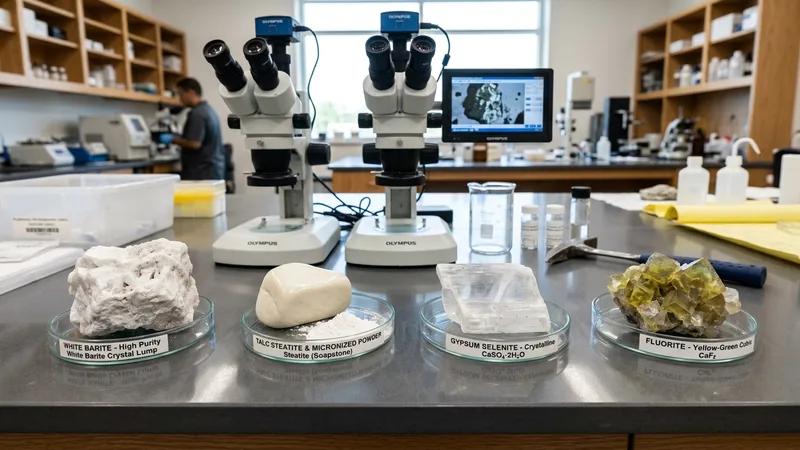
Industrial mineral values depend on physical attributes: specific gravity, d50 particle size distribution, oil absorption, and mineralogical purity rather than gross weight.
Industrial Mineral Stratigraphy & Formations
Pakistan possesses vast non-metallic mineral systems distributed across Paleozoic-Mesozoic sedimentary sequences, suture metamorphic terrains, and evaporite basins. Major belts include the Axial Belt barite-fluorite deposits of Balochistan, the Hazara-Khyber metamorphic belt hosting crystalline talc, magnesite, and phosphate, the extensive evaporite sequences of the Salt Range and Kohat Plateau hosting gypsum and silica sand, and the Thar-Nagar Parkar granitic terrain hosting kaolin and specialty clays.
Industrial Minerals Evidence Register
Official evidence classifications, verified regional belts, buyer specifications, and claim boundaries.
Mandatory Claim Boundary: Evidence classification describes the available regional record. It does not establish current Enigma Earth inventory, commercial grade, sale authority or immediate availability.
| Commodity & Mineralogy | Evidence Status | Primary Regional Belts | Example Buyer Requirements & Claim Boundary |
|---|---|---|---|
| Barite (Barytes / BaSO4) Barium Sulfate (BaSO4) Commercial SourcingDossier | [P]Official Production Evidence Sediment-hosted stratabound and hydrothermal vein deposits in Jurassic Shirinab Formation limestones in the Axial Belt fold-and-thrust belt. | Khuzdar (Gunga, Shekran, Monar Talar massive vein and bedded deposits) Haripur and Kohistan hydrothermal vein systems | Spec Target: Specific Gravity (SG) & BaSO4 Content Example Buyer Specification: Drilling Mud Grade typically requires Specific Gravity >= 4.20 g/cm3 (API 13A Section 7) or >= 4.10 g/cm3 (API Section 8); Chemical Grade: BaSO4 >= 95.0%. Lot-specific testing required. Limits: Water-soluble alkaline earth metals as calcium < 250 ppm, Cadmium < 3 ppm, Mercury < 1 ppm, Lead < 10 ppm Where an oilfield application requires an API specification (such as 4.20 or 4.10 g/cm3 specific gravity), the applicable parameters should be confirmed and demonstrated through suitable lot-specific testing. Khuzdar deposits maintain established commercial production with automated grinding mills; specific gravity and rheology must be verified per lot. |
| Talc / Soapstone (Steatite) Hydrated Magnesium Silicate (Mg3Si4O10(OH)2) Commercial SourcingDossier | [P]Official Production Evidence Hydrothermal alteration of Precambrian dolomites and magnesite beds along regional shear zones in the Lesser Himalayas. | Sherwan (Abbottabad), Safed Koh / Kurram, and Swat dolomitic belts | Spec Target: Whiteness / Brightness (Y-Value) & Chemistry + Mineralogy Example Buyer Requirement (Cosmetic/Polymer): ISO Brightness >= 94.0%, Talc purity >= 96.0%; Technical Grade: Brightness 85.0% - 92.0%. Chemistry and mineralogy must be verified by lot. Limits: Asbestos testing where required: certified absence of amphibole asbestos (tremolite, actinolite, anthophyllite) via accredited XRD/TEM; Acid-soluble substances < 2.0%, Fe2O3 < 0.50% Asbestos Testing Where Required: For applications where asbestos absence is required, representative material should be tested using an appropriate method and laboratory (e.g., XRD / TEM). Sherwan talc achieves high natural whiteness, but cosmetic and polymer suitability must be verified on a lot-by-lot basis. |
| Gypsum & Anhydrite Calcium Sulfate Dihydrate (CaSO4·2H2O) Commercial SourcingDossier | [P]Official Production Evidence Extensive evaporite formations in the Eocene and Cambrian sedimentary successions, occurring as massive beds 10 m to 100 m in thickness. | Salt Range (Khewra, Dandot, Daud Khel, Mianwali) Kohat Plateau (Bahadur Khel, Karak bedded sequences) Sulaiman Range (Barkhan, Kohlu, Spintangi formations) | Spec Target: CaSO4·2H2O Purity High Grade Plaster/Industrial: >= 90.0% CaSO4·2H2O; Cement Grade: >= 80.0% - 85.0% CaSO4·2H2O Limits: Chlorides (as NaCl) < 0.05% for cement and plasterboard; Silica (SiO2) < 2.5% Gypsum reserves in Punjab and KP are massive and commercially active. The primary commercial variables are logistics distance, purity consistency, and chloride content. |
Magnesite (Raw & Calcined) Magnesium Carbonate (MgCO3) Commercial Sourcing | [P]Official Production Evidence Metasedimentary crystalline magnesite replacement beds in Precambrian dolomites (Kumhar); cryptocrystalline vein magnesite from hydrothermal alteration of ultramafic serpentinites in ophiolites. | Kumhar (Abbottabad district, Hazara crystalline magnesite deposit) Muslim Bagh and Bela ophiolites (cryptocrystalline vein magnesite) | Spec Target: Magnesium Oxide (MgO) Equivalent Raw Magnesite: MgO >= 45.0% (LOI ~50%); Dead-Burned Magnesite: MgO >= 90.0% - 94.0% Limits: Silica (SiO2) < 2.5%, Calcium Oxide (CaO) < 2.0%, Iron (Fe2O3) < 1.0% (for Kumhar crystalline grade) Kumhar is Pakistan's principal documented crystalline deposit with historical geological reserve estimates. Processing into dead-burned magnesite requires high-temperature rotary kilns (>1750°C), which dictates local beneficiation capacity. |
| Fluorite (Fluorspar) Calcium Fluoride (CaF2) Commercial SourcingDossier | [P]Official Production Evidence Epithermal and hydrothermal open-space vein fillings and cavity replacements in Jurassic limestones and calcareous shales. | Koh-i-Maran and Koh-i-Siah (Kalat district); Kharan and Chagai vein deposits | Spec Target: Calcium Fluoride (CaF2) Metallurgical Grade (Metspar): 70.0% - 85.0% CaF2; Acid Grade (Acidspar): >= 97.0% CaF2 Limits: Silica (SiO2) < 5.0% for metspar (effective CaF2 calculation applies), Sulfur (S) < 0.05%, Phosphorus (P) < 0.03% Koh-i-Maran produces high-grade commercial metspar by manual sorting; production of acid-grade (>97% CaF2) requires froth flotation plants capable of separating calcite and silica gangue. |
Phosphate Rock (Phosphorite) Fluorapatite / Francolite (Ca5(PO4)3(F,Cl,OH)) Commercial Sourcing | [P]Official Production Evidence Sedimentary marine phosphorite beds hosted in the Cambrian Abbottabad Formation and Hazira Formation along the Hazara syntaxial zone. | Hazara Phosphate Belt (Kakul, Lagarban, Dalola, Tarnawai) | Spec Target: Phosphorus Pentoxide (P2O5) Direct Run-of-Mine: 24.0% - 28.0% P2O5; Beneficiated Concentrate: 30.0% - 32.0% P2O5 Limits: MER (Minor Element Ratio: (Al2O3 + Fe2O3 + MgO)/P2O5) < 0.10, Silica (SiO2) < 12.0%, Carbonate (CO2) < 5.0% Hazara phosphorites are silicious and dolomitic; commercial utilization in wet-process phosphoric acid requires careful blending or flotation beneficiation to keep MER within plant design tolerances. |
| Silica Sand (Industrial Quartz Sand) Silicon Dioxide (SiO2) Commercial SourcingDossier | [P]Official Production Evidence Mature quartz-arenite sandstone formations (Datta Formation) in the Salt Range; extensive hydrothermal quartz veins in Himalayan granites; coastal and desert dune sands. | Salt Range (Datta Formation sandstone: Kalabagh, Makarwal, Mianwali) Tharparkar and Dadu (unconsolidated silica sand dunes and Eocene beds) Dera Ismail Khan (Pezu) and Mansehra hydrothermal quartz veins | Spec Target: Silica (SiO2) & Iron Oxide (Fe2O3) Float/Flint Glass Grade: SiO2 >= 99.2%, Fe2O3 <= 0.025%; Container Glass: SiO2 >= 98.5%, Fe2O3 <= 0.08% Limits: Chromium (Cr2O3) < 2 ppm, Titanium (TiO2) < 0.03%, Refractory Heavy Minerals (zircon, sillimanite) < 5 grains per 500g Mianwali and Pezu silica sands provide established commercial production for domestic container glass; production of optical or solar cover glass requires high-intensity magnetic separation and acid washing. |
| Dolomite (Refractory, Glass & Metallurgical Flux) Calcium Magnesium Carbonate (CaMg(CO3)2) Commercial SourcingDossier | [P]Official Production Evidence Extensive marine dolostone beds and early diagenetic dolomitized limestone formations within Cambrian to Paleocene sedimentary successions. | Salt Range (Paikhel, Dandot, Nilawahan, Mianwali) Nowshera, Abbottabad, and Haripur dolomitic formations Kalat and Lasbela Jurassic carbonate belts | Spec Target: Magnesium Oxide (MgO) & Calcium Oxide (CaO) Refractory / Glass Grade: MgO >= 20.0% - 21.5%, CaO 30.0% - 31.5% (Theoretical pure: 21.8% MgO, 30.4% CaO) Limits: Iron (Fe2O3) < 0.10% for glass; Silica (SiO2) < 1.0% (metallurgical), < 0.5% (glass) High-purity refractory and glassmaker grades require low iron (Fe2O3 < 0.15%) and minimal acid-insoluble silica. Dolomitic limestone blends must be distinguished by precise XRF stoichiometry from true stoichiometric dolomite. |
| Bentonite (Sodium-Activated & Calcium Montmorillonite) Montmorillonite / Smectite ((Na,Ca)0.33(Al,Mg)2Si4O10(OH)2·nH2O) Commercial SourcingDossier | [P]Official Production Evidence Alteration of volcanic ash falls (tuffs) deposited in fluvial and lacustrine environments of the Neogene Siwalik Group; hydrothermal alteration of granitic basement. | Jhelum (Dina, Rohtas volcanogenic ash beds in Siwalik Group) Mirpur and Bhimber (Siwalik bentonite horizons) Tharparkar (Nagar Parkar kaolin) and Khairpur / D.G. Khan (Fuller's earth) | Spec Target: Swelling Index, Viscosity & Montmorillonite Purity API Drilling Grade: Suspension properties meeting API 13A (viscometer 600 rpm >= 30, filtrate volume <= 16.0 cm3); Swelling index >= 24 ml/2g Limits: Grit content (> 75 µm) <= 2.5%, Moisture 8.0% - 12.0% Most natural Pakistani bentonites are calcium-dominated smectites. Achieving API drilling specifications requires sodium activation (soda ash addition during pugging and aging). |
| Kaolin (China Clay) Kaolinite (Al2Si2O5(OH)4) Commercial SourcingDossier | [P]Official Production Evidence Intense in-situ chemical weathering and hydrothermal kaolinization of feldspar-rich granites and anorthosites. | Nagar Parkar (residual deposits on Proterozoic granitic basement) Shah Dheri (Swat district, hydrothermal alteration of feldspathic rocks) | Spec Target: Al2O3 Content & ISO Brightness Ceramic Grade: Al2O3 >= 34.0% - 37.0%, ISO Brightness >= 80.0%; Paper Coating Grade: Brightness >= 86.0% Limits: Iron (Fe2O3) < 0.8% (fires white), Titanium (TiO2) < 0.6%, Grit (> 45 µm) < 0.05% Nagar Parkar kaolin requires wet beneficiation (hydrocyclone separation, magnetic separation, and bleaching) to remove silica quartz grit and iron staining before reaching paper-coating standards. |
Barium Sulfate (BaSO4)
Hydrated Magnesium Silicate (Mg3Si4O10(OH)2)
Calcium Sulfate Dihydrate (CaSO4·2H2O)
Magnesite (Raw & Calcined)
Magnesium Carbonate (MgCO3)
Calcium Fluoride (CaF2)
Phosphate Rock (Phosphorite)
Fluorapatite / Francolite (Ca5(PO4)3(F,Cl,OH))
Silicon Dioxide (SiO2)
Calcium Magnesium Carbonate (CaMg(CO3)2)
Montmorillonite / Smectite ((Na,Ca)0.33(Al,Mg)2Si4O10(OH)2·nH2O)
Kaolinite (Al2Si2O5(OH)4)
Industrial Mineral Buyer Qualification Criteria
Purchasing industrial minerals from Pakistan requires exact verification of functional physical and chemical parameters tailored to the target processing industry:
Application-Specific Testing (Barite & Clays)
Where an oilfield application requires an API specification, the applicable parameters (such as 4.20 or 4.10 g/cm3 specific gravity and rheology) should be confirmed and demonstrated through suitable lot-specific testing.
Asbestos Testing Where Required (Talc)
For applications where asbestos absence is required, representative material should be tested using an appropriate method and laboratory (e.g., XRD / TEM).
Particle Size Distribution (PSD)
Verify laser diffraction particle size metrics (d10, d50, d98) for micronized fillers, rather than relying solely on simple sieve mesh ratings.
Fired Whiteness & Chemical Gangue
Ceramic materials (kaolin, feldspar, silica sand) require quantitative analysis of chromophore oxides (Fe2O3, TiO2) and firing trials at target kiln temperatures.
Packaging Moisture Barrier
Confirm heavy poly-lined multi-wall bags or jumbo bags to prevent atmospheric hydration and clumping during sea voyage transits.
Enigma Earth Governance & Operational Claim Boundaries
Evidence Disclaimer: Mineral occurrences, geological anomalies, or historical mining operations do not establish commercial ore reserves, immediate stockpiles, or guaranteed production. In strict adherence to Enigma Earth governance, every commercial proposition requires independent primary assay certification (SGS, Alex Stewart, or accredited equivalent) and statutory concession title validation.
Regional Mineral Context
Industrial mineral operations are situated near key processing centers and transport corridors. Explore regional context pages for road haulage, rail links, and port access.
Lasbela-Khuzdar Barite Belt, Koh-i-Maran Fluorite Belt, Muslim Bagh Magnesite
Sherwan-Hazara Talc & Magnesite Belt, Hazara Phosphorite Belt, Kohat Evaporite Basin
Salt Range Evaporite & Clastic Formations, Jhelum Siwalik Clay Belts
Nagar Parkar Granite Suite, Thano Bula Khan Celestite, Khairpur Fuller's Earth
Relevant Technical Services
Milling & Micronization Advisory
Evaluation of raymond mill, ball mill, and jet mill flowsheet configurations for barite, talc, and calcium carbonate micronization.
Processing OperationsBarite Specification & Testing Requirements
Pre-shipment inspection of specific gravity, wet sieve residues, soluble alkaline earth metals, and moisture barriers in big bags.
Export Quality AssayingDeposit Assessment & Leases
Geological resource estimation and concession title validation for non-metallic industrial mineral quarries across KP, Balochistan, and Punjab.
Concession AdvisoryRequest Technical Sourcing for Industrial Minerals
Submit your required technical parameters (SG, particle size d50, whiteness, chemistry) to receive qualified laboratory assays and logistical advice.