
Silica Sand Context & Buyer Requirements in Pakistan
Silica sand evaluation in Pakistan depends entirely on target application requirements—distinguishing between glass manufacturing, metal casting foundry sands, construction chemicals, and water filtration. Do not claim glass-grade or foundry-grade suitability without comprehensive grain sizing and trace iron (Fe2O3) assay testing.
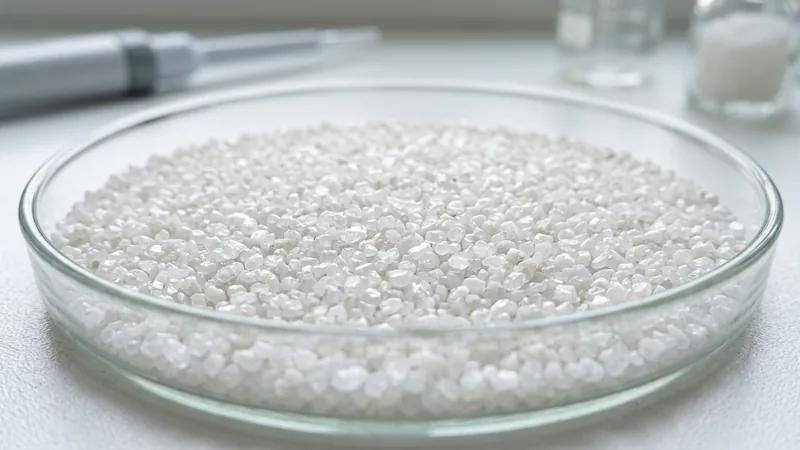
Mandatory Claim Boundary & Sourcing Notice: This page describes mineral/material evidence and buyer requirements. It does not represent current Enigma Earth inventory. Source, ownership, grade, quantity and availability must be verified for the specific enquiry.
Mineralogy & Geological Occurrence
Pakistan hosts extensive sedimentary silica sand deposits derived from quartz-rich sandstones and friable quartzite formations. Crucial for domestic industrial manufacturing, the material provides the principal silica source for flat glass, container glass, ceramic glazes, sodium silicate synthesis, and metal casting foundries.
Major deposits occur in the Mesozoic Datta Formation of the Salt Range and Surghar Range (Punjab and Khyber Pakhtunkhwa), where friable white sandstones yield high-silica quartz grains upon mechanical disaggregation. In southern Pakistan, extensive Tertiary sandstone horizons outcrop in Sindh (Dadu, Jamshoro, Thatta) and Tharparkar.
Predominantly monocrystalline alpha-quartz (SiO2 >= 95% - 99%). Accessory mineral contaminants include heavy minerals (ilmenite, rutile, zircon, tourmaline), feldspars (orthoclase, plagioclase), clay minerals (kaolinite), and iron hydroxide grain coatings.
Pakistan Evidence & Regional Context
Silica sand is extensively quarried and processed across Punjab, Sindh, and Khyber Pakhtunkhwa through licensed surface concessions, supplying national glass manufacturers, foundries, and chemical plants.
Mianwali (Datta, Chichali) & Salt Range Belts
Pakistan's premier commercial source for glass-grade silica sand, hosted in friable Jurassic sandstones; supported by mechanical washing and classifying plants.
Dadu, Jamshoro (Thano Bula Khan, Meting) & Tharparkar
Tertiary sedimentary sandstone outcrops supplying container glass manufacturers and Karachi foundry and construction clusters.
Pezu (Dera Ismail Khan) & Abbottabad Belts
Sandstone horizons yielding industrial silica sand for regional construction chemicals and ceramic industries.
Commercial Forms & Processing Stages
Commercial requirements must strictly differentiate between raw extraction, sorted grades, and processed products.
Glass-Grade Washed Silica Sand
High-purity, low-iron quartz sand subjected to attrition scrubbing, magnetic separation, and hydro-classification to achieve tight chemical and sizing specifications for glass furnaces.
Foundry & Metal Casting Sand
Uniformly graded, sub-angular to rounded silica sand with controlled acid demand value (ADV) and high refractory thermal stability, used in resin-coated and green sand foundry molds.
Construction Chemicals & Mortar Sand
Dried, dust-free quartz aggregate classified into narrow particle fractions for dry-mix mortars, tile adhesives, epoxy floor screeds, and grouts.
Water Filtration Media Sand
Clean, acid-washed quartz sand meeting AWWA B100 standards for municipal and industrial water treatment filtration beds.
Buyer Specification Requirements
Prospective buyers and project owners should specify the parameters below. Values represent typical industrial targets and do not imply universal Pakistani deposit compliance.
Chemical Composition & Trace Oxides
6 ParametersPhysical & Sizing Distribution
4 ParametersPackaging & Logistics
3 ParametersTesting & Verification Requirements
Testing and quality verification must be conducted by an appropriate independent laboratory. Commercial transactions require representative sampling, assay, chemical analysis or gemological appraisal, and third-party inspection. Enigma Earth does not maintain a private testing monopoly.
Automatic cross-belt stream sampling or tube increment collection across bagged production runs according to ISO 11648-2 standards. Homogenized rotary sample splitting.
- ASTM C146 (Standard Test Methods for Chemical Analysis of Glass Sand)
- ASTM C136 (Standard Test Method for Sieve Analysis of Fine and Coarse Aggregates)
- AFS 1105-00-S (AFS Grain Fineness Number Determination)
- AWWA B100 (Granular Filter Materials Standard)
Trace iron, titanium, and chromium must be quantified by high-precision ICP-OES or fused bead XRF to ensure compliance with glass-melting tolerances. Particle sizing requires certified calibration sieves.
Impurity Tolerances & Critical Penalty Factors
Commercial specifications require explicit thresholds for penalty elements, structural soundness, color uniformity, and treatment parameters.
Refractory Heavy Minerals (Chromite, Zircon, Andalusite)
Quality ParameterOperational Impact: Do not melt in glass furnaces at standard temperatures; form insoluble solid inclusions ('stones') that cause bottle breakage
Excess Iron Oxide (Fe2O3 > 0.08%)
Quality ParameterOperational Impact: Imparts an undesirable green or amber tint to flint glass containers and reduces solar panel glass transmission
Excess Fine Dust (< 75 microns / 200 mesh)
Quality ParameterOperational Impact: Causes severe dusting, filter clogging, and flux volatilization in furnace regenerators
Acid Demand Value (ADV > 5.0 ml in foundries)
Quality ParameterOperational Impact: Neutralizes acidic chemical binders in furan and polyurethane no-bake foundry sand systems, causing weak mold curing
Sourcing, Provenance & Preparation Logistics
Due diligence guidelines for legal chain of custody, packaging standards, and maritime export protocols.
Consignments require provincial transit challans from the Department of Mines & Minerals Punjab or Sindh, verifying legal extraction from permitted sandstone concessions.
Quarries operate under provincial mineral concession rules. Processing plants must comply with industrial water recycling standards and environmental dust mitigation regulations.
- 1.0 MT to 1.5 MT heavy-duty woven polypropylene bulk bags with polyethylene inner liners and discharge spouts
- 50 kg woven polypropylene valve bags packed on stretch-wrapped pallets
- Bulk pneumatic bulk tankers for direct discharge into silo storage
Transport via multi-axle dump trucks to domestic glass manufacturing clusters, or containerized freight via Karachi Port / Port Qasim for export consignments.
Relevant Regional Context
Technical Support for Industrial Mineral Requirements
Enigma Earth provides technical due diligence, commercial facilitation, and exploration services to de-risk mineral procurement in Pakistan.
Mineral Trading & Material Supply
Processing supervision, particle size classification audit, and continuous industrial supply contracts.
Mineral Exploration & Grain Analysis
Sandstone core logging, grain roundness appraisal, heavy mineral separation, and silica resource modeling.
Mining Consultancy & Washing Plant Design
Hydro-cyclone washing circuit engineering, magnetic separation optimization, and environmental water reclamation.
Commercial Pathways for Silica Sand (Industrial Quartz Sand)
Whether you are an international buyer seeking verified mineral supply or a licensed Pakistani mine operator looking to qualify off-take.
Mineral Buyers Registry
Review documented off-take requirements from industrial and international buyers.
Sell Your Mineral
Submit verifiable Silica Sand (Industrial Quartz Sand) parcels, stockpiles, or concessions for third-party qualification.
Mining Tenders & Leases
Monitor provincial DGMM lease auctions, block bidding, and concession notices.
Pakistan Mining Regions
Explore provincial mineral directorates, logistics corridors, and geological belts across Pakistan.
What to Send: Technical Requirement Checklist
To evaluate feasibility and structure compliant off-take, please include the following technical details in your enquiry.
Frequently Asked Questions: Silica Sand (Industrial Quartz Sand)
Key questions regarding Pakistani mineral availability, testing protocols, and trade qualification.
Glass manufacturing requires high chemical purity (typically SiO2 >= 98.5%) and critically low iron content (Fe2O3 < 0.04% for clear glass). Additionally, grain sizing must be tightly controlled between 106 and 600 microns, with zero refractory heavy mineral inclusions (such as chromite or zircon) that cause un-melted defects in glass containers.
Structure a Compliant Silica Sand (Industrial Quartz Sand) Requirement
Submit required SiO2 grade, Fe2O3 limits, and grain size distributions for technical qualification.